

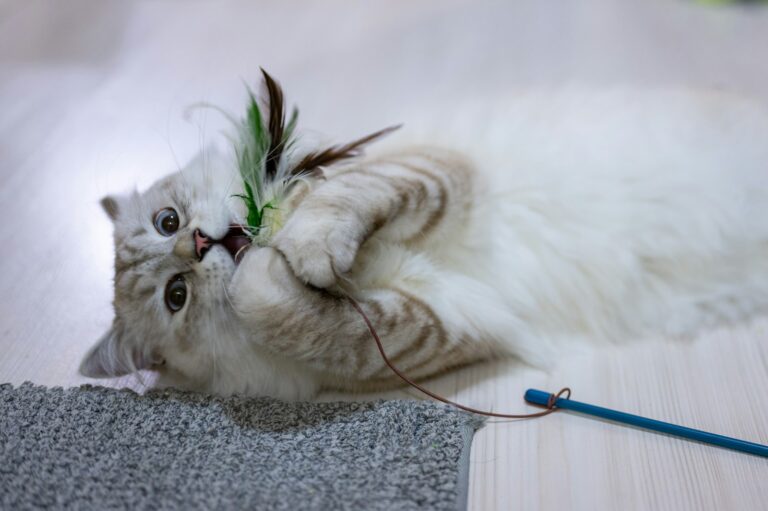
This guide shows you how to give an indoor cat everything it needs to stay active, calm and healthy: safe hiding spots, places to climb and scratch, daily play, smarter feeding and kind handling. The single most important takeaway is simple. Enrichment is not a bonus for indoor cats. Feline vets treat it as a basic need, just like food, water and a clean litter box.
Key takeaways
- Feline vet groups call meeting a cat’s environmental needs “essential (not optional)” for every pet cat, indoor or outdoor.
- A healthy cat home rests on five pillars: a safe place, separate key resources, play and hunting outlets, predictable human contact and respect for scent.
- Most guidance lands on two or three short play sessions a day, often 10 to 15 minutes each.
- Food puzzles and scattered meals let cats “work” for food the way hunting cats do, and can help with boredom and weight.
- Scratching posts should let an adult cat stretch out fully; International Cat Care suggests at least 60 cm (about 24 inches).
- Put string, ribbon and wand toys away after play, and keep true lilies and daylilies out of the house.
- A sudden change in behavior, grooming or litter habits is a reason to see the vet, not just to buy more toys.
In this guide
- What is indoor cat enrichment, and why does it matter?
- The five pillars of a healthy cat home
- How much play does an indoor cat need?
- Feeding as enrichment: food puzzles and foraging
- Climbing, perches and window views
- Scratching: the right posts in the right places
- Safe places, hiding spots and scent
- Enrichment by life stage and household
- Safe outdoor time: harnesses and catios
- Keeping enrichment safe
- Signs your cat needs more enrichment
- When to call the vet
- Frequently asked questions
- Quick answers
What is indoor cat enrichment, and why does it matter?
Enrichment means shaping your home and routine so your cat can do the things cats are built to do: hunt, climb, scratch, explore, hide and rest in safety. It matters because indoor cats that cannot do these things are more likely to become bored, stressed and overweight.
Your cat may live on a sofa, but its brain still belongs to a small predator. VCA’s behavior team notes that an outdoor cat might catch as many as 10 small animals in a day. A review of food puzzles in the Journal of Feline Medicine and Surgery adds that hunting cats make several attempts each day, and only about half succeed. That is a lot of stalking, chasing and problem-solving. Indoors, a full bowl appears with no effort at all.
Keeping cats indoors has real benefits. VCA points out that indoor cats avoid traffic, predators, fights with other cats and infections such as feline leukemia virus and FIV. The goal is not to send your cat outside. It is to bring the good parts of the outdoors inside.
What can go wrong without enrichment?
International Cat Care (iCatCare) says indoor cats can develop problems linked to a sedentary life, including urinary tract disease, over-grooming and eating problems. The AAHA/AAFP life stage guidelines note that obesity is most common in middle age and that enrichment, more activity and individual food portions can lower that risk.
Bladder health is a clear example. The Cornell Feline Health Center says lower urinary tract signs show up most often in middle-aged, overweight cats that get little exercise, use an indoor litter box and drink less water. Cornell also says stress seems to be an important factor in feline idiopathic cystitis, the most common diagnosis in these cats, and that enrichment and changes to the home can reduce how often and how badly episodes happen.
Is every cat the same?
No. VCA puts it plainly: there is no one-size-fits-all plan. Some cats love chasing, others love puzzles, and some just want a warm perch and a view. Ohio State’s Indoor Pet Initiative suggests offering every change as a choice, then watching your cat. If something makes your cat jump, cower, hide or shake, take it away.
The five pillars of a healthy cat home
The American Association of Feline Practitioners (AAFP) and the International Society of Feline Medicine (ISFM) built their environmental needs guidelines around five “pillars.” Use them as a checklist: if your home covers all five, you have the foundation in place.
| Pillar | What it means | Easy ways to meet it |
|---|---|---|
| 1. A safe place | A private spot where the cat can retreat and feel secure | A covered bed, a box on a shelf, a quiet room; at least one per cat |
| 2. Multiple, separated key resources | Food, water, litter, scratching, play and rest spots in more than one place | Keep the litter box away from food; spread resources around the home |
| 3. Play and predatory behavior | Chances to stalk, chase, pounce and “catch” | Daily wand-toy sessions, food puzzles, toy rotation |
| 4. Positive, predictable human contact | Handling and attention on the cat’s terms, in a steady routine | Let the cat approach you; keep feeding and play times regular |
| 5. Respect for the sense of smell | Scent is how cats read their world and feel at home | Avoid strong cleaners on cat areas; let cats scratch and rub to leave scent |
The guidelines stress one more idea: these needs apply to all pet cats, whatever their lifestyle. They also note that cats often hide stress well, so needs tend to be ignored until a problem shows up. Planning ahead is easier than fixing a behavior problem later.
Why “separated” resources matter
Cats do not like to eat next to their toilet, and many prefer water away from food. In homes with more than one cat, a single feeding station or litter area can turn into a guarded zone. Spreading things out lets each cat get what it needs without passing a rival. Cornell suggests at least one more litter box than the number of cats, kept clean and in quiet spots. Our guide on how often to clean a cat litter box covers the cleaning schedule.
Water stations count too
iCatCare suggests one water container per cat plus one extra, placed in different spots. It also notes that some cats dislike the chemical smell of tap water and that many like a bowl filled to the brim so they can drink without dipping their head. More water options can help cats drink more, which supports bladder health. If your cat suddenly starts drinking far more than usual, though, that is a health question; read why is my cat drinking so much water?
How much play does an indoor cat need?
Most experts suggest two or three short interactive play sessions a day, often 10 to 15 minutes each. Sources differ on the exact number, so treat these figures as a starting point and adjust to your cat’s age, health and energy.
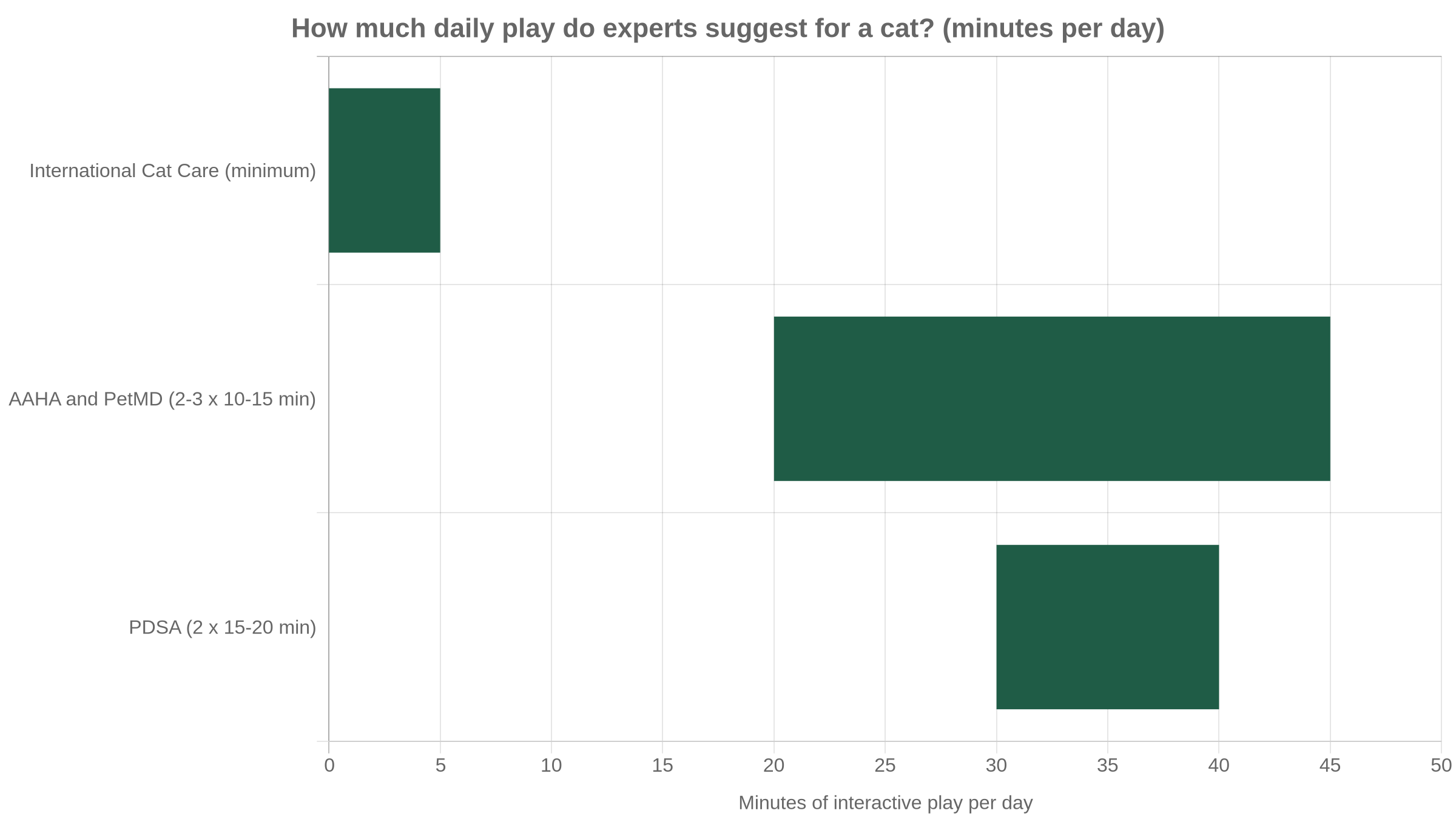
Here is how the advice compares. iCatCare’s “Purrfect Play” campaign asks owners to play for at least five minutes a day, a low bar meant to build the habit. AAHA and PetMD veterinarian Jenny Alonge both point to two or three sessions of 10 to 15 minutes. VCA asks for at least three short sessions. The UK charity PDSA suggests starting with two sessions of 15 to 20 minutes and building up as the cat gets fitter. In short, somewhere between a few minutes and about 45 minutes a day, broken into bursts.
How to play like a hunter
AAHA describes the cat’s hunting sequence as stare, stalk or chase, pounce, grab and kill. Good play follows that order. Try this simple routine:
- Start slow. Move a wand toy along the floor and around furniture, away from your cat, the way prey would flee.
- Build the chase. Let the toy dart, pause and hide. Cats love the moment it disappears behind a chair.
- Let your cat win. Allow real catches, not just endless near-misses.
- Wind down. Slow the toy so your cat can cool off.
- End with a “kill” and a meal. Humane Colorado suggests feeding a little canned food about five minutes after a session ends.
VCA recommends toys that mimic real prey in size, texture and movement: a “bird” that flutters, a “mouse” that scurries, a “bug” that skitters. It also suggests timing play just before the times your cat is naturally active or starts seeking attention. Many cats get lively around dawn and dusk.
Keep toys fresh
iCatCare describes cats as drawn to novelty, so rotating toys keeps them interesting. Put most toys away and bring out a few at a time. VCA agrees: offer variety and swap toys often. A toy that has been hidden for a week can feel brand new.
Never use your hands as toys
VCA warns against letting a cat chase or pounce on any part of you, because even small bites or scratches can become infected. Cats Protection explains that cats who lack outlets for “prey” play may redirect it onto people, such as grabbing ankles. A wand toy keeps claws at a safe distance.
If your cat sleeps much of the day between sessions, that is usually normal. See is it normal for my cat to sleep so much? for what healthy sleep looks like.
Feeding as enrichment: food puzzles and foraging
Making your cat work a little for its food is one of the easiest ways to add daily enrichment. Food puzzles, scattered portions and several small feeding spots all turn a two-minute meal into an activity.
The 2016 food puzzle review by Leticia Dantas, Mikel Delgado, Ingrid Johnson and Tony Buffington notes that most pet cats are fed from a bowl, often share feeding areas and spend almost no effort getting calories. The authors propose food puzzles as a natural fix. They also shared case reports from their practices where puzzles helped with health and behavior concerns, while noting this is still a young area of research.
Types of food puzzles
| Type | How it works | Best for |
|---|---|---|
| Mobile (balls, eggs, tubes) | The cat rolls or bats it, and kibble drops out | Active cats that like to chase; dry food |
| Stationary (mazes, wells, towers) | The cat paws or licks food out while the puzzle stays put | Older or less mobile cats; wet or dry food |
| Lick mats and shallow wells | Wet food is spread thin and licked out slowly | Wet-food eaters; fast eaters |
| DIY puzzles | Egg cartons, paper cups or bottles with holes cut in them | Trying puzzles on a budget |
| Scattered meals | Small portions placed in several dishes around the home | Encouraging walking and exploring |
How to introduce a food puzzle
- Make it easy at first. Start with a puzzle where food falls out with almost no effort, then raise the challenge.
- Use some, not all, of the meal. Keep a regular bowl available while your cat learns.
- Check that food is actually eaten. VCA warns that cats can become seriously ill if they do not eat enough calories each day.
- Be patient. The review authors say that, given time and a gradual start, most cats can adjust to puzzles.
Puzzles work with both wet and dry diets. If you are deciding between them, our wet vs dry cat food guide compares water content, calories and cost. Slow feeder bowls are another option for cats that gulp; see our roundup of slow feeder cat bowls.
Treats and “people food” rewards
Treats are useful for training and for luring cats onto a new perch or post. Keep them small, and count them as part of the day’s food. VCA notes that leaving food out all day can add to weight gain in sedentary cats, so measured meals plus puzzles are usually better than a bowl that never empties. Many owners use a flake of tuna or a crumb of cheese as a reward. Read can cats eat tuna? and can cats eat cheese? before you do.
Climbing, perches and window views
Cats feel safer and more relaxed when they can rest high up and watch the room. Adding vertical space, such as a cat tree, wall shelves or a cleared bookcase top, makes a small home feel bigger to a cat.
iCatCare calls cats natural climbers and stresses the value of high resting places. VCA calls cat trees “aerobic centers” that offer climbing, hiding and play, and gives three practical tips:
- Put the tree where the family spends time, not in a back room or garage. Cats want to be near the action.
- Set it a little away from the wall if you can, so your cat can jump on from different angles.
- Add a soft, non-slip bed to favorite high spots, like the top of a fridge or bookcase.
VCA adds a useful warning. It is fine for a cat to choose a high spot for a nap. It is not fine if the cat stays up high because it is too frightened to join the family. If that sounds like your cat, look at what is scaring it, whether that is another pet, a child or noise.
For homes with more than one cat, a tall tree with several platforms helps cats share space. Our guide to cat trees for multiple cats covers designs with more perches.
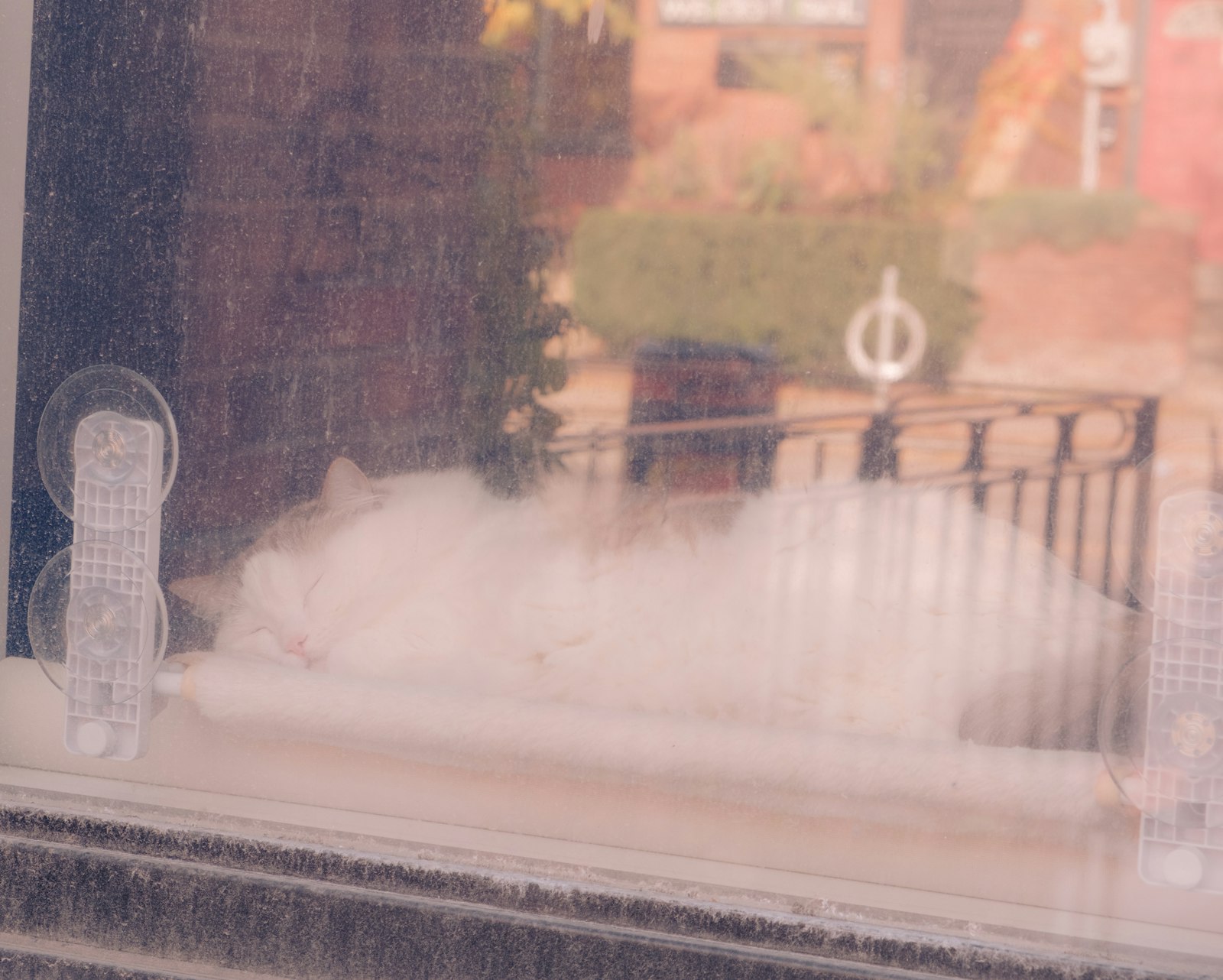
Window seats and “cat TV”
A window perch with a view of birds, squirrels or a busy street is free entertainment. VCA notes that some cats enjoy television, while others prefer a perch near a window. Humane Colorado suggests ending bird-watching or screen time with a play session where your cat can actually catch something, so it does not stay frustrated. If your cat makes odd clicking sounds at the window, that is normal; see why does my cat chatter at birds?
Scratching: the right posts in the right places
Scratching is a normal, necessary behavior. Cats scratch to stretch, keep their claws in shape and leave scent marks. The fix for a shredded sofa is not to stop scratching but to offer posts your cat likes more.
VCA explains that when cats scratch, they leave pheromones that help them feel secure at home. That links scratching directly to the AAFP/ISFM pillar on scent. A cat that scratches in the living room is, in part, making the room smell like home.
What makes a good scratching post?
- Height. iCatCare advises a post tall enough for a full stretch, with a minimum of 60 cm (about 24 inches) for an adult cat.
- Stability. A post that wobbles or tips will be abandoned. A heavy, wide base matters.
- Direction. iCatCare notes that cats scratch both upright and flat surfaces but often prefer one. If your cat attacks rugs and stair treads, try a flat scratcher. If it targets sofa arms and table legs, go vertical.
- Texture. iCatCare says materials with a vertical weave let cats drag claws downward, though many cats happily use posts with sisal wrapped around them.
- Placement. Put posts next to the spots your cat already scratches, and near sleeping areas, since many cats scratch after waking.
Regular nail trims help too. Our step-by-step guide on how to trim your cat’s nails walks through the process. Kneading soft blankets is a different behavior from scratching; read why do cats knead? to learn more.
Safe places, hiding spots and scent
Every cat needs at least one private place to retreat to when it feels unsure. VCA, summarizing the AAFP/ISFM guidelines, says you should have at least as many safe spaces as you have cats, and that many cats prefer them raised.
A safe place can be simple. Ohio State’s Indoor Pet Initiative notes that snug blankets and towels appeal to cats as much as bought beds, and are easy to wash. A cardboard box on its side, a covered bed or a quiet bedroom can all work. The key rule: when your cat is in its hideout, leave it alone. Do not pull it out for visitors or to give medicine if you can avoid it.
Working with your cat’s nose
Cats rely on smell to feel at home, so a house that suddenly smells different can be unsettling. A few habits help:
- Wash cat bedding in rotation, not all at once, so some familiar scent always remains.
- Use mild, unscented cleaners near cat areas, and avoid strong scents near litter boxes.
- Let your cat rub its face on furniture and on you. That rubbing deposits scent; see why does my cat headbutt me?
- Offer safe new smells for exploring, such as a paper bag or box brought in from shopping. iCatCare suggests new scents and safe household items as cheap novelty.
Catnip is another scent-based treat that many cats enjoy. It is generally safe; our article is catnip bad for your cat? covers the details. Not every cat responds to it, and that is normal.
Predictable people
The fourth pillar is about you. Cats do best with steady routines and handling they can predict. Ohio State notes that cats are not pack animals like people and dogs, and respond better to rewards than to scolding. Let your cat start contact, keep petting sessions short and stop before your cat gets restless. Feed and play at roughly the same times each day. Daily brushing or combing, if your cat enjoys it, is another form of gentle contact; see how often should you brush your cat?
Enrichment by life stage and household
Enrichment should change as your cat ages and as your household changes. Kittens need lots of short, active play; senior cats need easier access and gentler games; multi-cat homes need more of everything.
| Cat or home | Focus on | Watch out for |
|---|---|---|
| Kittens | Many short play bursts, safe toys, early handling | String, ribbon and small parts; unsupervised wand toys |
| Young and prime adults | Daily hunting-style play, food puzzles, climbing | Weight gain after neutering; boredom behaviors |
| Senior cats | Ramps or steps to perches, low-impact play, stationary puzzles | Pain or stiffness that makes jumping hard |
| Multi-cat homes | Extra litter boxes, water bowls, perches and hideouts in several rooms | Cats guarding doorways, food or litter areas |
| Homes with dogs or children | High escape routes and dog-free or child-free retreats | Being chased; never having a quiet place |
Kittens
The AAFP-AAHA life stage guidelines note that kittens have a strong drive to play, that play with other cats peaks around 12 weeks, and that play with objects becomes more common after that. Toys give that energy a target so it does not land on your hands. The AAHA/AAFP guidelines also say obesity prevention starts in kittenhood, since neutering is linked with weight gain.
Senior cats
Older cats still benefit from play, but sessions can be shorter and slower. Even batting at a toy while lying down counts. Ramps or steps up to favorite spots help a stiff cat keep using its perches. Our senior cat care guide covers home changes for cats 10 and older.
Active breeds
AAHA notes that some breeds have higher energy and need more frequent play. Bengals are a well-known example; see are Bengal cats good with kids? for how their energy plays out at home. Calmer breeds, such as the one in our British Shorthair breed guide, may prefer shorter games, but they still need daily activity to stay trim.
Safe outdoor time: harnesses and catios
You can give an indoor cat fresh air without the dangers of free roaming. The two main options are harness walks and a secure enclosure, often called a catio.
Harness training
VCA says that with training and patience, most cats can learn to walk on a cat-safe harness and leash. The keys are going slowly and making it rewarding:
- Let your cat sniff the harness, then reward it.
- Put the harness on for short periods indoors, with treats and play as a distraction.
- Practice walking indoors until your cat is fully relaxed.
- Only then go outside, to a quiet place such as your own yard, away from traffic and dogs.
Some cats never enjoy a harness, and that is fine. Our roundup of cat harnesses for walking covers styles to consider.
Catios and secure gardens
VCA notes that ready-made catio kits are sold, some companies build custom ones, and a catio can be attached to almost any window or door. PDSA also suggests a catio or a secure garden for indoor-only cats. Add shelves, a shaded spot and a way back inside so your cat can retreat whenever it wants.
Even indoor-only cats can get out by accident. The AAHA/AAFP guidelines say indoor cats still need veterinary care and microchips, and that indoor-only cats still face a real risk of parasites. Ask your vet what prevention plan fits your cat.
Keeping enrichment safe
Good enrichment should never put your cat at risk. The biggest dangers are swallowed string-like toys, toxic plants and unstable furniture.
String, ribbon and wand toys
PDSA says never to leave a cat alone with string, thread, twine or wool, because swallowed string can cause a serious gut blockage, something its vets see often. iCatCare warns that ribbons, string and wool can cause the intestines to bunch up if eaten, which may need emergency surgery. It also advises avoiding pipe-cleaner toys, which can be sharp. VCA and iCatCare both say not to leave wand toys out unattended. After play, put them in a closed cupboard.
VCA also warns against toys small enough to swallow. Check toys often and throw out any that are falling apart.
Plants and flowers
The ASPCA Animal Poison Control Center warns that several lilies, including Easter lily, tiger lily, Japanese show lily and some daylilies, can cause kidney failure in cats. All parts of the plant are considered toxic, and even small amounts can cause severe poisoning. The ASPCA says that without prompt treatment a cat can develop kidney failure in about 36 to 72 hours. If you think your cat has touched or chewed a lily, call your vet or an emergency clinic right away. The ASPCA also keeps a searchable list of plants that are toxic and non-toxic to cats; check it before adding houseplants. Cat grass is a popular, cat-friendly alternative for chewers.
Furniture and play spaces
Cornell’s Feline Health Center advises making sure no heavy objects can fall on your cat during wild play. Anchor tall cat trees and bookcases, and close off gaps behind appliances. For a room-by-room checklist, see our tips for cat-proofing your home.
Signs your cat needs more enrichment
A bored or stressed cat often shows it through behavior: scratching furniture, attacking ankles, over-grooming, yowling, gaining weight or toileting outside the box. These signs can also mean illness, so rule out health problems first.
PetMD veterinarian Jenny Alonge lists over-grooming, aggression toward people or pets, destructive scratching and excessive vocalizing as common signs of an under-stimulated cat. She adds that sudden or major changes deserve a call to the vet. Other things to look for include:
- Waking you at night or pestering for food between meals
- Ambushing other pets or people
- Steady weight gain on the same amount of food
- Seeming dull, uninterested or withdrawn
- Overreacting to small changes in the home
If you see these, start small. Add one daily play session, swap half of one meal into a puzzle and add a perch by a window. Give each change a week or two before judging it. The AAFP/ISFM guidelines note that meeting a cat’s needs helps reduce unwanted behavior and stress-related illness, but change takes time.
When to call the vet
Call your vet whenever your cat’s behavior, appetite, grooming or litter habits change suddenly. Enrichment cannot fix pain or illness, and many behavior changes in cats have a medical cause.
Get help right away if your cat:
- Strains to pee and produces little or no urine. Cornell calls urethral obstruction an absolute emergency. Male cats are at higher risk, and Cornell says death can follow in less than 24 to 48 hours without treatment.
- Has eaten or touched any part of a lily, or another plant on the ASPCA toxic list.
- May have swallowed string, ribbon, thread or a toy part, or is vomiting, not eating or seems in pain after play.
- Has a sudden injury from a fall or a toppled cat tree.
Book a vet visit soon if your cat:
- Pees outside the box, pees often, cries while peeing, has blood in its urine or licks its genitals a lot. Cornell lists these as signs of lower urinary tract disease.
- Starts over-grooming, especially if bald patches appear.
- Suddenly stops playing, jumping or climbing, which can be a sign of pain.
- Gains or loses weight without a change in food.
- Drinks far more water than usual, or sneezes often; see why is my cat sneezing so much?
When you call, describe what you have seen as clearly as you can: what changed, when it started and how often it happens. Our list of signs that your cat may be sick can help you know what to watch for.
Frequently asked questions
Do indoor cats get bored?
Yes. Without chances to play, climb, scratch and explore, indoor cats can become bored and stressed. Daily play, food puzzles and vertical space are the simplest fixes.
Is it cruel to keep a cat indoors?
Not if its needs are met. Indoor cats avoid traffic, predators, fights and some infectious diseases. The trade-off is that you must provide the activity and stimulation the outdoors would have offered.
Will getting a second cat cure boredom?
Not always. The AAFP/ISFM guidelines note that cats who enjoy other cats’ company are often related, or have lived together since kittenhood. A new cat can add stress, so fix the environment first and introduce any newcomer slowly.
Are laser pointers good for cats?
Many cats love chasing a light, but they can never catch it. If you use one, end the game by switching to a toy your cat can grab, or a treat, so the hunt has a finish.
Are tablet games for cats OK?
VCA mentions touch-screen games where cats bat at moving “prey” as a fun option for some cats. Treat them as an extra, not a replacement for real, hands-on play.
Do I need to spend a lot on enrichment?
No. Cardboard boxes, paper bags with handles removed, DIY food puzzles from egg cartons, a cleared windowsill and ten minutes with a wand toy cost very little. Rotation keeps cheap toys interesting.
My cat ignores toys. What should I try?
Try different “prey” types, such as feathers, furry mice or crinkly bugs, and move them like real animals: away from the cat, hiding and pausing. Play at dusk, keep sessions short and check with your vet if your cat has also become less active overall.
Quick answers
- Is it normal for my cat to sleep so much? Yes; healthy adults often sleep 12 to 16 hours a day.
- Why does my cat chatter at birds? It is excitement or frustration at prey it cannot reach.
- Why do cats knead? It is a comfort behavior left over from kittenhood.
- Why does my cat headbutt me? To leave its scent and show trust.
- How often should you clean a litter box? Scoop daily and wash the box about weekly.
- Is catnip bad for your cat? No, it is generally safe in normal amounts.
- How often should you brush your cat? Daily for long coats, about weekly for short coats.
- Can cats eat tuna? A little plain tuna as a rare treat, never as a daily food.
Sources
- AAFP and ISFM Feline Environmental Needs Guidelines, Journal of Feline Medicine and Surgery (via catvets.com)
- Feline Environmental Needs Guidelines, VCA Animal Hospitals
- Cat Behavior and Training: Enrichment for Indoor Cats, VCA Animal Hospitals
- Keeping cats indoors, International Cat Care
- Scratching and choosing a scratch post, International Cat Care
- Purrfect Play Every Day campaign, International Cat Care
- Playing with your kitten, International Cat Care
- Food puzzles for cats: Feeding for physical and emotional wellbeing, Journal of Feline Medicine and Surgery
- Environmental Enrichment for Confined Cats, Ohio State University Indoor Pet Initiative
- Keeping Cats Indoors, Ohio State University Indoor Pet Initiative
- Feline Lower Urinary Tract Disease, Cornell Feline Health Center
- Safe toys and gifts, Cornell Feline Health Center
- How often should you play with your cat?, AAHA
- 2021 AAHA/AAFP Feline Life Stage Guidelines: Life Stage Checklists, AAHA
- AAFP-AAHA Feline Life Stage Guidelines (2010), Journal of Feline Medicine and Surgery
- Exercise for your cat, PDSA
- Secrets to Keeping Your Indoor Cat Happy, PetMD
- Cats and play, Cats Protection
- What is feline enrichment and why is it important?, Humane Colorado
- Cat enrichment: play with your cat, Humane Colorado
- Lily Hazards for Cats, ASPCA Animal Poison Control Center (via CFA)
This article is general information and is not a substitute for advice from your veterinarian.
How we researched this guide: this guide is based on published guidelines and articles from veterinary organizations, universities and animal welfare charities listed above. Catish has not tested any of the products mentioned.