

This guide explains how to care for a senior cat: when old age starts, how often to see the vet, which illnesses to watch for, what to feed, and how to make your home easier on aging joints. The single most important takeaway is this: never write off a change in an older cat as “just old age.” Most problems that come with age can be managed, and they are far easier to manage when they are caught early.
Key takeaways
- Most veterinary groups call a cat “senior” at about 10 or 11 years old, though some cats show age-related changes from age 7.
- Feline vet guidelines advise checkups at least every 6 months for cats aged 10 to 15, and every 4 months for healthy cats over 15.
- Kidney disease, an overactive thyroid, arthritis, dental disease and cognitive decline are the big five problems of old age. All are easier to manage when found early.
- Weight loss, drinking more, peeing more, hiding, missing the litter box and night-time yowling are warning signs, not normal aging.
- There is no single best “senior diet.” The right food depends on your cat’s weight, muscle and medical conditions.
- Small home changes help a lot: low-sided litter boxes, ramps or steps, warm padded beds, and food and water on every floor.
- Older cats groom less well, so daily brushing, weekly claw checks and regular tooth brushing matter more than ever.
In this guide
- When is a cat considered a senior?
- What changes as a cat gets older?
- How often should a senior cat see the vet?
- What health problems are common in senior cats?
- What should you feed a senior cat?
- How do you set up your home for an older cat?
- Grooming, claws and teeth
- Behavior, stress and play
- A simple weekly home health check
- When to call the vet
- Quality of life and planning ahead
- Frequently asked questions
- Quick answers
When is a cat considered a senior?
A cat is usually considered a senior from about 10 or 11 years of age. The exact number depends on who you ask, and every cat ages at its own pace.
The 2021 life stage guidelines from the American Animal Hospital Association (AAHA) and the American Association of Feline Practitioners (AAFP) put cats in the senior group at 10 years and older. VCA Animal Hospitals uses 11 to 14 years for “senior” and calls cats over 14 “geriatric.” International Cat Care also starts at 11, and uses the label “super-senior” for cats of 15 and up.
The labels matter less than what you see in your own cat. The Cornell Feline Health Center notes that many cats start to show age-related physical changes between 7 and 10 years, and most do by 12. The AAFP senior care guidelines add that some cats are best treated as seniors from as early as 8.
| Source | Life stage labels |
|---|---|
| AAHA/AAFP Feline Life Stage Guidelines (2021) | Kitten: birth to 1 year. Young adult: 1 to 6. Mature adult: 7 to 10. Senior: 10 and older. |
| VCA Animal Hospitals | Senior: 11 to 14 years. Geriatric: over 14 years. |
| International Cat Care | Senior: 11 to 14 years. Super-senior: 15 years and up. |
| Cornell Feline Health Center | Age-related changes often begin between 7 and 10 years, and in most cats by 12. |
How old is my cat in human years?
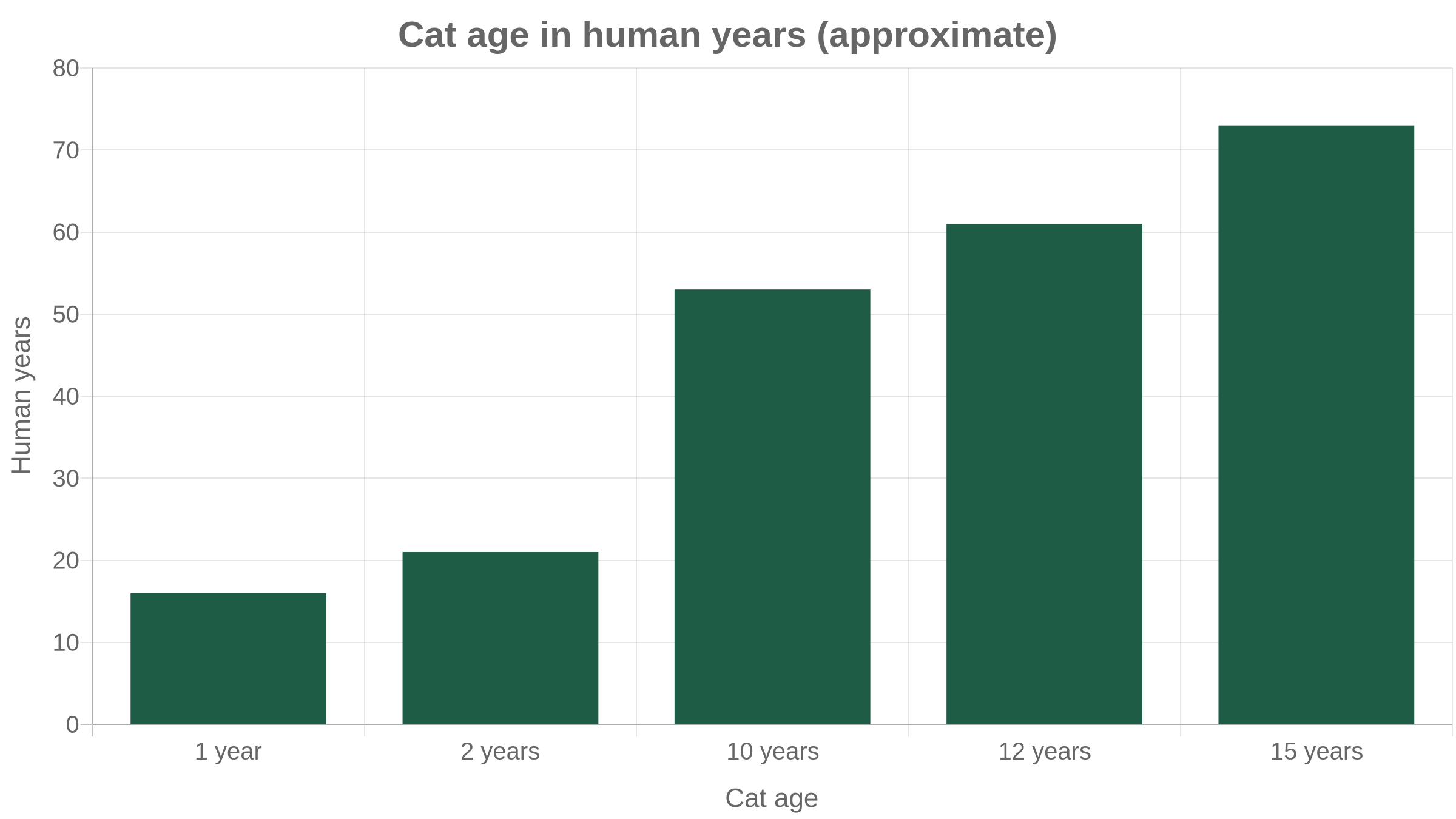
The old “one cat year equals seven human years” rule is not accurate. Cornell explains that a 1-year-old cat is roughly like a 16-year-old person, and a 2-year-old cat is like a 21-year-old. After that, each cat year counts for about four human years.
By that math, a 10-year-old cat is about 53 in human terms, a 12-year-old is about 61, and a 15-year-old is about 73. This is why six months is a long time in an older cat’s life. A lot can change between checkups.
What changes as a cat gets older?
Aging brings slow changes to almost every body system, from the immune system to the senses, skin, joints and brain. Age itself is not a disease, but these changes make illness more likely and make an older cat less able to cope with it.
Cornell and VCA describe a similar list of normal changes:
- Weaker immune defenses. Older cats fight off infections less well, and long-term illness can weaken immunity further.
- Thinner skin. The skin becomes less elastic, has poorer blood flow, and is easier to injure or infect.
- Poorer grooming. Older cats groom less well, which can lead to mats, skin odor and sore skin.
- Thick, brittle claws. Claws often overgrow because they are not shed and worn down as they used to be.
- Duller senses. Hearing loss is common. Smell and taste can fade, which can make a cat less keen on food. The sense of thirst may drop too.
- Eye changes. A slight haze in the lens and a lacy look to the iris are common and do not seem to affect sight much. Sudden vision loss is different and is often tied to high blood pressure.
- Less efficient digestion. Some older cats absorb nutrients less well, which, together with moving less, can cause muscle loss.
- Stiffer joints. Arthritis is common, even though most affected cats never visibly limp.
- Brain changes. Some cats become confused, vocal at night or less social.
Is it old age, or is my cat sick?
You often cannot tell without a vet, and that is the point. Cornell’s advice is blunt: do not assume a change in an older cat is due to age and so cannot be treated. Any change in behavior or body condition is a reason to call your vet.
Cats are also very good at hiding illness. A cat can have a serious problem and show almost nothing until it is advanced. Our list of signs that your cat may be sick is a useful companion to this guide.
How often should a senior cat see the vet?
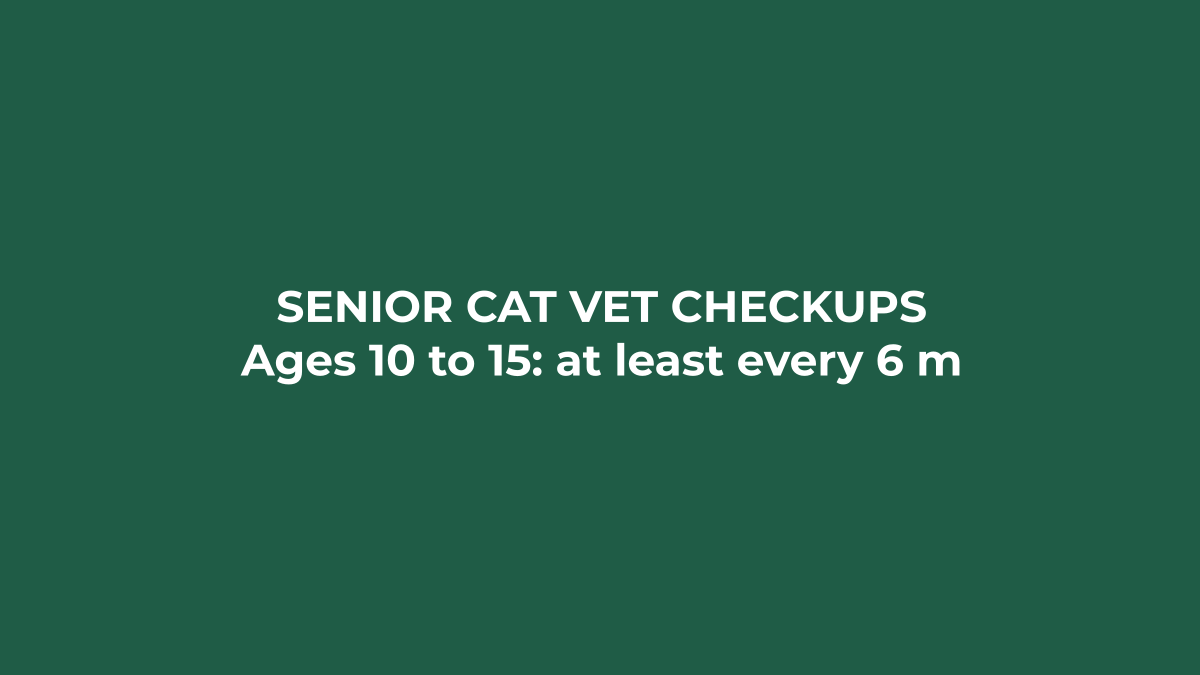
Plan on a checkup at least every six months once your cat is 10, and more often after 15 or if your cat has a long-term illness. Twice-yearly visits are the standard advice from the main feline veterinary groups.
When the AAHA/AAFP life stage guidelines were released, AAHA’s chief medical officer, Dr. Heather Loenser, put it simply: “we recommend checkups every six months for senior cats.” The AAFP’s 2021 senior care guidelines go a step further. They advise a minimum of every six months for cats aged 10 to 15, and every four months for healthy cats over 15. Cats with chronic conditions may need to be seen more often than that.
| Cat’s age or status | Suggested checkup frequency | Source |
|---|---|---|
| Any age | Full physical exam at least once a year | AAHA/AAFP |
| 10 to 15 years, healthy | At least every 6 months | AAFP senior care guidelines |
| Over 15 years, healthy | Every 4 months | AAFP senior care guidelines |
| Any senior with a chronic illness | As often as your vet advises; often more frequent | AAFP, VCA |
What happens at a senior checkup?
Your vet will ask about behavior and habits at home, examine your cat from nose to tail, and compare weight, body condition and muscle condition with past visits. Cornell and VCA both note that blood tests, a urine test and a fecal test are commonly recommended at least once a year for seniors.
These tests matter because they can pick up kidney disease and thyroid disease before a cat looks ill. Blood pressure is worth checking too. Cornell reports that about 60% of cats with chronic kidney disease also develop high blood pressure.
You can help by bringing notes: appetite, water intake, litter box habits, any vomiting, and any change in jumping, grooming or sleep. Small details from home are often what point the vet in the right direction.
What health problems are common in senior cats?
The most common problems in older cats are chronic kidney disease, hyperthyroidism, arthritis, dental disease and cognitive decline. High blood pressure, diabetes, inflammatory bowel disease and cancer also become more common with age, according to Cornell.
| Condition | Signs you may notice at home |
|---|---|
| Chronic kidney disease | Drinking and peeing more, weight loss, poor appetite, dull or unkempt coat, low energy |
| Hyperthyroidism | Weight loss despite a big appetite, more thirst and urination, restlessness, vomiting or diarrhea |
| Arthritis | Hesitating before jumps, choosing lower surfaces, less grooming, less play, litter box misses |
| Dental disease | Drooling, tilting the head while eating, reluctance to eat, irritability, red or bleeding gums |
| Cognitive dysfunction | Night-time yowling, seeming lost, staring at walls, changed sleep, litter box accidents |
| High blood pressure | Often nothing until sudden vision changes, disorientation or weakness |
Chronic kidney disease
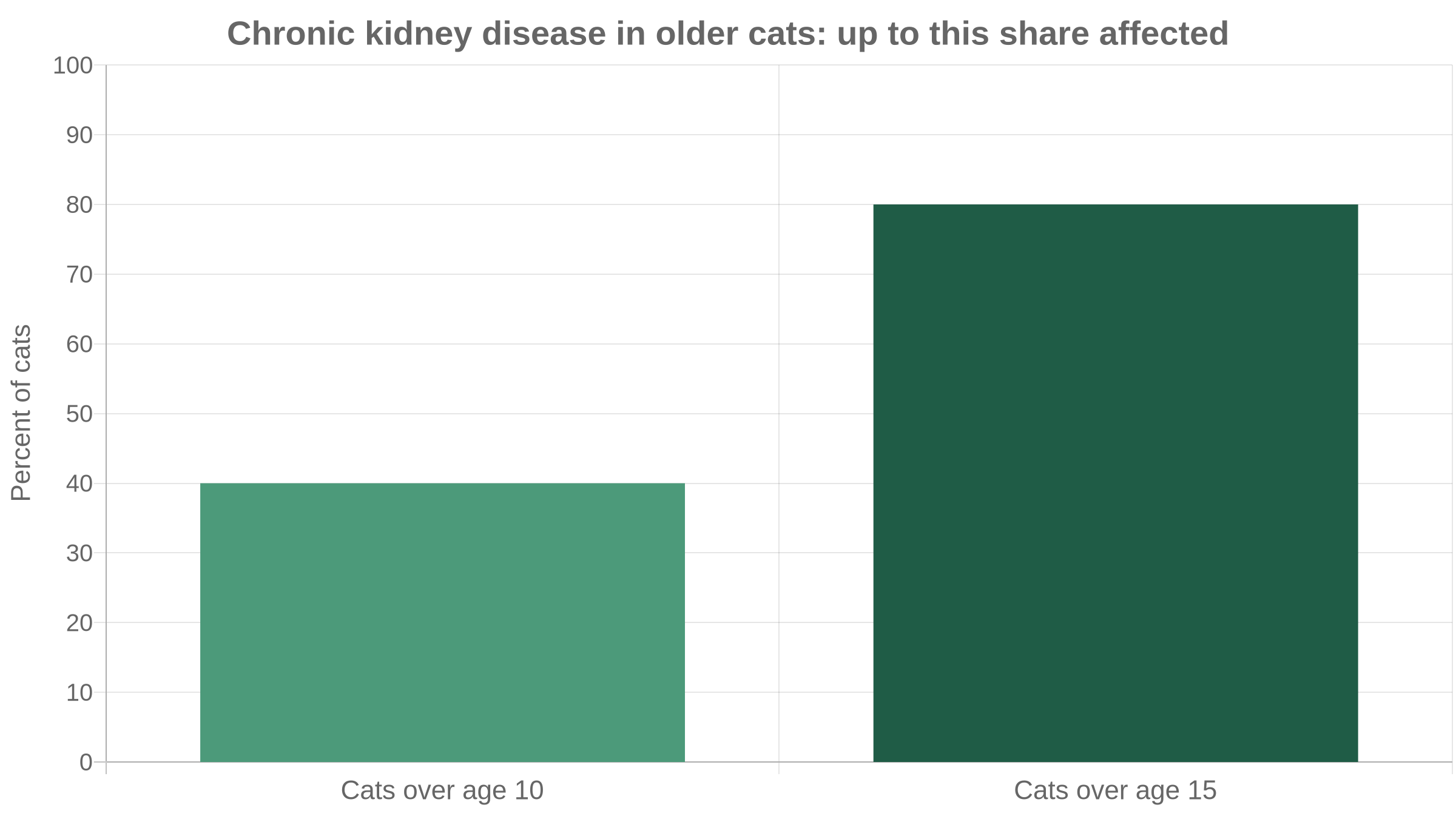
Chronic kidney disease (CKD) is one of the most common illnesses of old age in cats. Cornell reports it affects up to 40% of cats over 10 and up to 80% of cats over 15. Age is the only known risk factor, which is why every senior cat should be screened.
Early CKD usually has no visible signs, because the body makes up for the lost function. As the kidneys lose their ability to concentrate urine, cats pee larger amounts and drink more to keep up. Later, waste products build up in the blood, and cats may lose weight, go off their food, and look tired and unkempt. If you have noticed the water bowl emptying faster, read why is my cat drinking so much water and book a vet visit.
Diagnosis rests on blood and urine tests. Cornell explains that a newer blood marker, SDMA, tends to rise when about 40% of kidney function is lost, while the older marker, creatinine, often does not rise until close to 75% is gone. Poorly concentrated urine can be one of the earliest clues of all.
CKD cannot be cured, but it can be slowed. Prescription kidney diets are the best-proven tool. Cornell cites studies in which cats with CKD on a kidney diet lived two to three times longer than cats on regular food. Good hydration, blood pressure control and regular monitoring make up the rest of the plan. The earlier CKD is found, the better the outlook tends to be.
Hyperthyroidism
Hyperthyroidism means the thyroid gland makes too much hormone. It mostly affects middle-aged and older cats. The classic picture is a cat that eats well, or even ravenously, and still loses weight.
Cornell lists weight loss, a bigger appetite, and more thirst and urination as the most common signs. Vomiting, diarrhea and hyperactivity can also occur. The cause is not known. Because thyroid disease can affect other organs, vets pay close attention to the heart and kidneys in these cats.
The good news is that there are four treatment routes: medication, radioactive iodine therapy, surgery and a special diet. Each has pros and cons, and the right choice depends on your cat’s overall health and your own situation. That is a conversation for you and your vet.
Arthritis
Arthritis is very common in older cats and very easy to miss, because cats rarely limp. Instead, they quietly do less.
International Cat Care points to a 2002 study in which 90% of cats over 12 had signs of degenerative joint disease on X-rays. The charity describes the main signs as reduced mobility, hesitating or refusing to jump, jumping to lower surfaces than before, and jumping less often. VCA adds less play, less grooming, grumpiness, and peeing or pooping outside the litter box.
Arthritis pain can be treated, but pain medicine for cats must come from your vet. International Cat Care stresses that the safety of these drugs varies and that long-term use needs care. Never give a cat human painkillers. Weight control also matters, because extra weight makes sore joints worse. The home changes later in this guide are a big part of arthritis care.
Dental disease
Dental disease is extremely common and painful, and it is a leading reason older cats eat less. Cornell cites studies showing that between 50% and 90% of cats over four years old have some form of it.
The three most common forms are gingivitis (inflamed gums), periodontitis (damage to the tissues that hold the teeth) and tooth resorption, in which the tooth breaks down. Cats with a sore mouth may drool, turn the head to one side while chewing, become irritable, or stop eating. An older cat that walks to the bowl and then walks away may have a mouth problem, not a fussy streak.
Cognitive dysfunction (cat dementia)
Cognitive dysfunction is an age-related decline in brain function, with signs that resemble dementia in people. Cornell says the signs tend to become clear in cats aged 10 and older.
Signs include getting lost in familiar places, staring into space or at walls, changed sleep cycles, loss of interest in play or food, litter box accidents, and loud crying, often in the middle of the night. How common is it? In a study described by veterinary behaviorist Dr. Gary Landsberg in Discover magazine, nearly 30% of cats aged 11 to 14 showed signs, rising to nearly 50% of cats over 15.
The catch is that other illnesses cause the same signs. Cornell notes that night-time yowling is fairly common in cats with an overactive thyroid or high blood pressure, that kidney disease can change litter box habits, and that arthritis can keep a cat from reaching the box in time. A vet needs to rule those out first. A quick note on one sign that is easy to confuse: friendly head rubbing is normal, but pressing the head against a wall is not. Our short article on why cats headbutt explains the difference.
High blood pressure, diabetes and cancer
High blood pressure in cats is usually the result of kidney disease or hyperthyroidism, Cornell explains. It often gives no warning. When signs do appear, they can be sudden: vision changes, confusion, weakness or heart problems. This is one reason blood pressure checks are part of good senior care.
Diabetes also raises urine output, so it can look like kidney disease from the outside. Cancer becomes more common with age too. Cornell’s warning list includes lumps, sores that do not heal, and unexplained weight loss. Run your hands over your cat often and report any new lump, along with where it is and when you found it.
What should you feed a senior cat?
Feed a complete, balanced food that keeps your cat at a healthy weight with good muscle, and change it only for a reason. There is no one “senior diet” that suits every older cat, and experts do not fully agree on the details.
Here is where sources differ. Royal Canin’s veterinary nutrition material points out that, although cat life stages have been defined, there are still no specific nutritional guidelines for senior cats. Veterinary nutritionist Dr. Lisa Freeman of Tufts has written that many older cats do very well staying on a good-quality adult food, that the ideal protein level for older cats is still debated, and that foods very low in protein may contribute to muscle loss. Dr. Kathryn Michel of the University of Pennsylvania has told WebMD there is little research proving that healthy seniors need something different from younger adults.
What they agree on is that food should be matched to the individual cat. If you are comparing products, see our roundup of cat food for senior cats, and run any switch past your vet first.
Watch weight and muscle, in both directions
Cornell notes that many cats get heavier as they age, while others become too thin. Both matter. Extra weight strains arthritic joints. Weight loss in an older cat is often an early sign of illness, such as kidney disease or an overactive thyroid.
Muscle matters as much as the number on the scale. VCA suggests feeling along the spine and hips while you pet your cat. In a healthy cat, those bones should not be easy to feel. If they are becoming sharper, tell your vet, even if your cat seems fine.
Should I switch to a kidney diet as a precaution?
No. Therapeutic diets, including kidney diets, are for cats that have been diagnosed with the condition, and they should be chosen with your vet. Kidney diets are restricted in protein, phosphorus and sodium. That helps cats with CKD, but, as Freeman notes, heavy protein restriction may be too little for many other older cats.
What if my senior cat is not eating well?
First, treat it as a medical sign. Dental pain, kidney disease and a fading sense of smell can all blunt appetite. Royal Canin suggests gently warming food to bring out the aroma. Cornell advises making any diet change gradually and paying attention to temperature, texture and flavor.
Strong-smelling treats can tempt a picky eater, but they should not replace balanced meals. Before you reach for the can, check can cats eat tuna for how much is safe. A cat that stops eating altogether needs a vet promptly. Cornell warns that cats with CKD can develop serious problems after even fairly short periods without food.
How do I keep a senior cat hydrated?
Make water easy to reach and appealing. Older cats are more prone to dehydration, especially with kidney disease, and their sense of thirst may be weaker.
- Put several clean water bowls around the home, in easy-to-reach spots.
- Try a water fountain. Cornell notes many cats prefer them.
- Feed wet food, and consider stirring in a little extra water, as International Cat Care suggests.
- Raise bowls slightly off the floor if your cat seems stiff when bending down.
VCA offers a quick check: healthy, well-hydrated gums are pink and moist. Gums that feel sticky or look pale deserve a call to the vet. For choosing dishes, see our guide to food and water bowls for cats.
How do you set up your home for an older cat?
Make everything your cat needs easy to reach without jumping, climbing or squeezing. Small changes to litter boxes, beds, bowls and routes around the house can make a large difference to comfort.
| Problem | Simple fix |
|---|---|
| High-sided litter box is hard to step into | Use a box with low sides or a cut-out entry |
| Stairs between the cat and the litter box, food or water | Put a box, food and water on every floor your cat uses |
| Favorite perch is now too high | Add steps or a ramp to the sofa, bed or window sill |
| Hard or cold sleeping spots | Offer warm, well-padded beds in quiet, draft-free places |
| Slippery floors | Lay non-slip mats on the routes your cat uses most |
| Stiff cat flap | Prop it open so your cat does not have to push through |
Litter boxes
Joint pain can make climbing into a box hurt, and Cornell notes that this alone can push a cat to go elsewhere. A box with low sides, or a cut-out entrance, solves much of that. VCA recommends having more than one litter area so a box is always close by.
Keep boxes extra clean. Cats with kidney disease, diabetes or thyroid disease produce more urine, so the box gets dirty faster, and a dirty box is another reason to avoid it. Our short answer on how often to clean a litter box gives a schedule, and we have more ideas in ways to reduce litter box smells.
Beds, warmth and getting around
Older cats sleep more and feel the cold more. International Cat Care suggests soft beds in quiet, draft-free spots that are easy to get to, and notes that igloo-style beds can help an older cat feel warm and secure. Cats Protection adds that hammock-style radiator beds are especially warm.
Cats still like height, so do not take perches away. Give them a way up instead. Steps or ramps to the sofa, bed and favorite window keep a stiff cat in the middle of family life. VCA also suggests non-slip mats.
Grooming, claws and teeth
Older cats need help with grooming because they do it less well themselves. A short daily routine keeps the coat, claws and mouth healthy and doubles as a health check.
Brushing
Cornell recommends daily brushing or combing. It removes loose hair before it is swallowed, which lowers the chance of hairballs, and it boosts blood flow to the skin. VCA notes that brushing also helps cats reach the spots arthritis has put out of range.
Be gentle. Older skin is thin and tears more easily. If you find knots, work slowly and follow our guide to de-matting a cat. A coat that has suddenly become greasy, matted or scruffy is worth mentioning to your vet, since it can mean your cat is in pain or unwell.
Claws
Check claws once a week. Older cats use scratching posts less, and both Cornell and VCA warn that their claws can grow thick and curl around into the paw pad, which is painful. If you are new to trimming, see how to trim your cat’s nails, or ask your vet team to show you.
Teeth
Cornell calls tooth brushing with a pet toothpaste the single most effective way to prevent dental disease. Use only products made for cats, because human toothpaste can be toxic to them. Most cats can learn to accept brushing, but it may take weeks or months of slow, calm practice. Our step-by-step guide on how to brush your cat’s teeth walks through it.
Even if brushing is not possible, lift the lip now and then and look. Red, swollen or bleeding gums need a vet visit.
Behavior, stress and play
Senior cats do best with a steady routine, low stress and gentle daily play. They adapt to change less easily than they once did, but they still need company and things to do.
Keep stress low
Cornell advises cutting stress wherever you can. A new pet can be very hard on an older cat and is best avoided if possible. If you travel, having a friend, neighbor or sitter care for your cat at home is kinder than boarding. If boarding or a house move cannot be avoided, bring familiar bedding and toys, and give extra attention and affection.
Keep the mind and body busy
VCA recommends play with favorite interactive toys, food-dispensing toys that copy hunting, and safe raised perches for watching the world. Keep sessions short and easy on the joints. Positive, predictable contact with you counts as enrichment too.
If your cat enjoys catnip, it can add interest to a quiet day. See is catnip bad for your cat for the details. Also remember that fading sight and hearing can make an older cat jumpy. Approach where your cat can see you, and avoid startling a sleeping cat.
Helping a confused cat
For cats with cognitive decline, Cornell’s suggestions are practical: keep litter boxes close and low-sided, add ramps where stairs are a struggle, avoid bringing in new animals, and keep up routine vet visits. Once other illnesses are ruled out, a vet may be able to prescribe medication to ease anxiety and night-time distress.
A simple weekly home health check
Spend five minutes once a week checking your cat over while you pet them. Cornell suggests making it a natural part of normal cuddles, and asking your vet to show you what to look for.
- Mouth. While scratching the chin, lift the lip. Look for red gums, broken teeth and bad breath.
- Ears and eyes. Lift the ear flaps and look inside. Check for discharge from the eyes or nose.
- Coat and skin. Stroke the whole body. Feel for lumps, scabs, mats and sore spots.
- Body and muscle. Feel along the spine and hips. Note any new boniness.
- Claws and paws. Check claw length and look at the pads.
- Habits. Think back over the week: eating, drinking, litter box, jumping, sleeping spots and mood.
Weigh your cat regularly if you can, and keep a simple log. A written record makes slow changes visible, and slow changes are exactly the ones that are easy to miss when you see your cat every day.
When to call the vet
Call your vet for any lasting change in your senior cat’s behavior, appetite, weight, thirst or litter box habits. Do not wait for the next routine checkup, and do not try to treat an older cat at home with human medicines.
Seek urgent veterinary care for:
- Collapse or seizures
- Difficulty breathing, or fast breathing (Cornell gives more than 35 breaths per minute as a guide)
- Straining to pee, painful urination, or producing little or no urine
- Sudden blindness, sudden confusion or sudden weakness
- Not eating at all
Book a prompt appointment for:
- Weight loss, or a spine and hips that feel bonier
- Drinking more (Cornell’s guide is more than one ounce per pound of body weight a day) or peeing more
- Eating less, trouble chewing or swallowing, drooling, or red or bleeding gums
- Vomiting, diarrhea, blood in the stool, or dark, tarry stool
- Constipation: dry, hard stool, straining, or going less often
- Peeing or pooping outside the litter box
- Low energy, hiding, or a change in temper
- Stiffness, an odd gait, or no longer jumping
- An unkempt coat, heavy shedding, skin sores or sores that do not heal
- New lumps or bumps
- Coughing, or discharge from the eyes or nose
- Night-time yowling, seeming lost, or apparent deafness
Quality of life and planning ahead
Good senior care is a partnership between you and your vet, and it has to work for both the cat and the household. It helps to talk openly about what you can manage before a crisis arrives.
The AAFP senior care guidelines ask vets to consider four “budgets” when they plan treatment with an owner: money, time, emotional energy and physical ability. These differ for every family. Being honest about them is not a failure of love. It leads to a plan you can actually keep up.
The same guidelines introduce the idea of frailty, borrowed from human medicine, and put quality of life at the center of decisions. In practice, that means asking simple questions often. Is my cat eating? Moving about? Grooming? Seeking company? Still doing the things that make them who they are? Many older cats live with one or more long-term conditions and still enjoy life for years.
One last thought: if you are thinking of adopting, do not overlook older cats. Cornell notes that senior cats in shelters are often calmer, are more likely to be litter trained, and make wonderful companions.
Frequently asked questions
At what age is a cat a senior?
Most guidelines say around 10 or 11 years. AAHA and the AAFP use 10 and older, while VCA and International Cat Care start at 11. Some cats show age-related changes from about 7.
How long do cats live?
Cats are living longer than they used to. Cats Protection says it is no longer unusual for a cat to reach 18, and Cornell notes that some reach 20 or 21. Good home care, nutrition and veterinary care all play a part.
Do senior cats need special senior food?
Not always. Many healthy older cats do well on a good adult food, and experts disagree on the ideal recipe for seniors. Cats with a diagnosed condition, such as kidney disease, may need a prescription diet chosen by a vet.
Why is my old cat losing weight?
Weight loss in an older cat should always be checked. Common causes include kidney disease, an overactive thyroid and dental pain. Older cats may also digest food less efficiently and lose muscle.
Why does my senior cat yowl at night?
Night-time crying can be a sign of cognitive dysfunction. It is also fairly common in cats with hyperthyroidism or high blood pressure, so a vet visit comes first. Pain and fading senses can add to the confusion.
Is it normal for an older cat to sleep more?
Some extra sleep is expected with age. However, a cat that moves around much less, or sticks to just one or two sleeping spots, may be in pain or unwell. Mention it to your vet.
Should I get a kitten to keep my senior cat company?
Usually not. Cornell warns that a new pet can be a stressful experience for an older cat and is best avoided where possible. Extra time with you is a safer way to add company.
How can I tell if my senior cat is in pain?
Look for behavior changes, not crying or limping. Hesitating before jumps, grooming less, playing less, hiding, grumpiness when touched, and litter box misses are typical signs. A vet can assess pain and discuss safe treatment.
Quick answers
- Why is my cat drinking so much water? A sudden rise in thirst can point to kidney disease, diabetes or an overactive thyroid, so see a vet.
- How often should you clean a cat litter box? Scoop at least once a day and wash the whole box about once a week.
- Can cats eat tuna? A little plain canned tuna is fine as an occasional treat for most healthy cats, but never as a daily food.
- Why does my cat headbutt me? It is a friendly way to share scent and show trust. Pressing the head against walls is different and needs a vet.
- Why do cats knead? Kneading is a normal comfort behavior left over from kittenhood.
- Is catnip bad for your cat? The short answer is no, with a few details worth knowing.
Sources
- The Special Needs of the Senior Cat, Cornell Feline Health Center
- Chronic Kidney Disease, Cornell Feline Health Center
- Hyperthyroidism in Cats, Cornell Feline Health Center
- Cognitive Dysfunction, Cornell Feline Health Center
- Feline Dental Disease, Cornell Feline Health Center
- 2021 AAFP Senior Care Guidelines, Feline Veterinary Medical Association
- Updated Senior Care Guidelines, Feline Veterinary Medical Association
- AAHA and AAFP Release Updated Feline Life Stage Guidelines, AAHA
- Helping Senior Cats Age Gracefully, VCA Animal Hospitals
- Elderly cats: special considerations, International Cat Care
- Osteoarthritis in cats: diagnosis and treatment (International Cat Care), Your Cat
- Elderly cats, Cats Protection
- Can Cats Get Dementia? What Are the Best Warning Signs?, Discover Magazine
- Feeding the Older Cat to Optimize Health and Longevity (Lisa M. Freeman), Veterinary Information Network
- Feeding Your Senior Cat, WebMD
- Nutrition of aging cats, Royal Canin
- How to care for an elderly cat, Royal Canin
This article is general information and is not a substitute for advice from your veterinarian.