

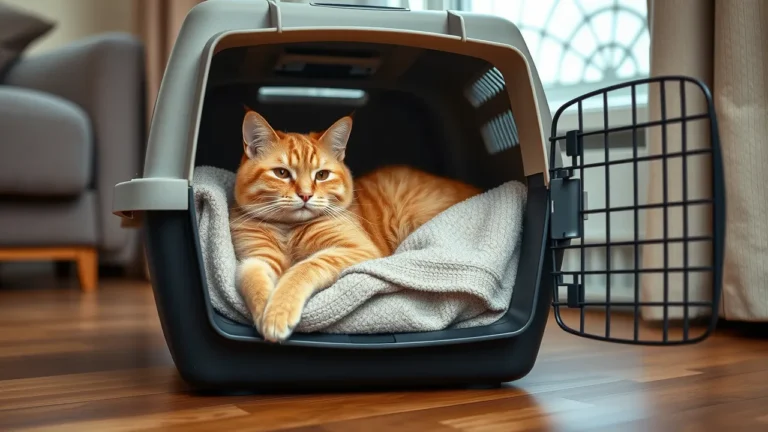
To get your cat used to a carrier, leave it out all the time as a cozy resting spot, fill it with treats and a familiar blanket, and train in small steps until your cat walks in on their own. The key is patience: move to the next step only when your cat is relaxed with the current one.
Key takeaways
- Keep the carrier out where your cat likes to spend time, not stored in a closet or garage.
- A hard plastic carrier with a removable top is the easiest and safest choice for vet visits.
- A few minutes of training a day is enough. If your cat gets nervous, go back a step.
- Carry the carrier from underneath, not by the handle, and give each cat its own carrier.
- Kittens learn fastest, but cats of any age can learn to accept a carrier.
Why does my cat hate the carrier?
Many cats only see the carrier when it comes out of storage for a car ride and a vet visit, so they learn to link it with stress. The American Association of Feline Practitioners (AAFP) notes that this stress can lead owners to skip vet visits, which can harm a cat’s health. Changing what the carrier means to your cat is the fix.
What kind of carrier is best?
The AAFP recommends a hard plastic carrier, which it calls the safest and easiest to clean. Choose one with a top that comes off, so your cat can stay in the bottom half during a checkup and feel more secure. If you use a soft carrier, look for a large top opening and doors that do not collapse. The AAFP advises against backpack-style carriers because they are cramped and unstable, and says a harness and leash is not a safe way to travel.
How do you carrier train a cat, step by step?
This plan follows the AAFP’s six steps, with tips from the Connecticut Humane Society:
| Step | What to do |
|---|---|
| 1 | Get your cat to lie or sleep on a soft “security” blanket. |
| 2 | Put that blanket in the bottom half of the carrier, with the top off. Add treats or toys. |
| 3 | Put the top back on and reward your cat for staying calm inside. |
| 4 | Close the door for a moment while your cat is relaxed, then open it again. |
| 5 | Slowly increase how long the door stays closed. |
| 6 | Lift the carrier from underneath and help your cat get comfortable being carried. |
The Connecticut Humane Society says only a few minutes of training a day can help a cat start to see the carrier as a resting spot and a source of treats. If your cat seems worried, return to the last step where they were comfortable. Once training is done, keep the carrier out as another bed so the progress sticks.
How do you keep a cat calm in the car?
- Cover the carrier with a blanket or thick towel to block out sights and sounds.
- Secure it on the floor between the front and back seats, which the AAFP calls the safest spot.
- Keep the car quiet, well ventilated and at a comfortable temperature.
- Do not open the carrier during the drive, even if your cat meows.
- If you use a calming cat pheromone spray, spray the blanket, not your cat, at least 15 minutes before travel while your cat is out of the room.
Need the basics before you bring a cat home? Our new cat supplies guide covers what to buy.
What if my cat still panics?
Some cats stay fearful despite training, often because of past bad experiences. The AAFP says your veterinarian may be able to prescribe medicine to help your cat stay calm, or treat travel sickness if your cat drools or vomits in the car. Regular checkups matter, especially as cats age, so it is worth asking. See our senior cat care guide for how often older cats need visits.
Frequently asked questions
How long does carrier training take?
It depends on the cat. Go at your cat’s pace and only move on once they are relaxed with each step, rather than following a fixed timeline.
Can two cats share one carrier?
No. The AAFP and the International Society of Feline Medicine advise one carrier per cat, even for cats that get along, because travel stress can change how they act toward each other.
Should I put my cat in the carrier by force?
Ideally your cat walks in on their own. If you must place them inside, the AAFP says to do it gently and calmly.
Sources
- Getting Your Cat to the Veterinary Practice, American Association of Feline Practitioners
- Carrier Training Cats, Connecticut Humane Society
- Visiting Your Vet Guide, International Society of Feline Medicine
This article is general information and is not a substitute for advice from your veterinarian.