

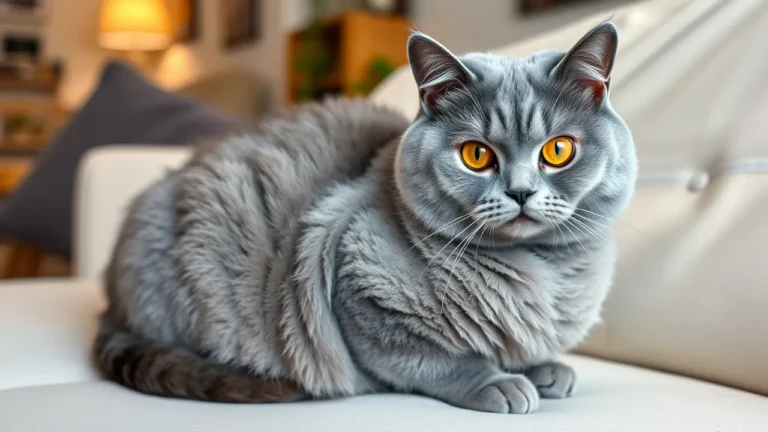
This guide covers everything you need to know before living with a British Shorthair: where the breed came from, how big it gets, what it is like at home, and how to care for its famous plush coat. The most important takeaway is simple: British Shorthairs are easygoing cats, but they gain weight easily and carry a few inherited health risks, so portion control and a breeder who health-tests are what matter most.
Key takeaways
- The British Shorthair is Britain’s oldest-documented pedigree cat and its most popular one today: about half of all kittens registered with the GCCF each year are British.
- Males are clearly bigger than females, and the breed can take up to five years to reach full size.
- Expect a calm, patient, quiet cat that likes being near you but often prefers not to be carried.
- The dense coat needs a weekly comb and extra attention during seasonal shedding, but rarely a bath.
- Weight gain is the most common everyday problem. Measure meals and keep your cat playing.
- Ask breeders about PKD DNA testing, heart (HCM) ultrasound screening, ALPS testing and blood type.
- Published life expectancy ranges from about 10 to 20 years depending on the source, so careful care counts.
In this guide
- British Shorthair at a glance
- Where does the British Shorthair come from?
- What does a British Shorthair look like?
- How big do British Shorthairs get?
- What is the British Shorthair personality like?
- Living needs: indoor life, play and other pets
- Grooming a British Shorthair
- Feeding a British Shorthair
- British Shorthair health problems and screening
- How long do British Shorthairs live?
- Cost of ownership
- Breeder or adoption?
- Who is a British Shorthair right for?
- When to call the vet
- Frequently asked questions
British Shorthair at a glance
The British Shorthair is a medium to large, heavily built cat with a round face, a very dense short coat and a calm temperament. The table below sums up the basics; each point is explained in more detail later in this guide.
| Trait | What to expect |
|---|---|
| Origin | Great Britain |
| Weight | Males about 9–17 lb, females about 7–12 lb (GCCF); some sources list lower ranges |
| Maturity | Up to 5 years to reach full physical maturity |
| Coat | Short, very dense and plush; described as “crisp” |
| Classic color | Blue (gray), with many other colors and patterns |
| Temperament | Patient, tolerant, quiet, a little lazy as an adult |
| Grooming | Weekly comb; more during shedding seasons |
| Main health watch-outs | Weight gain, HCM (heart), PKD (kidneys), blood type B, ALPS in kittens |
| Lifespan | Breed bodies say 14–20 years; UK vet-record studies report lower averages |
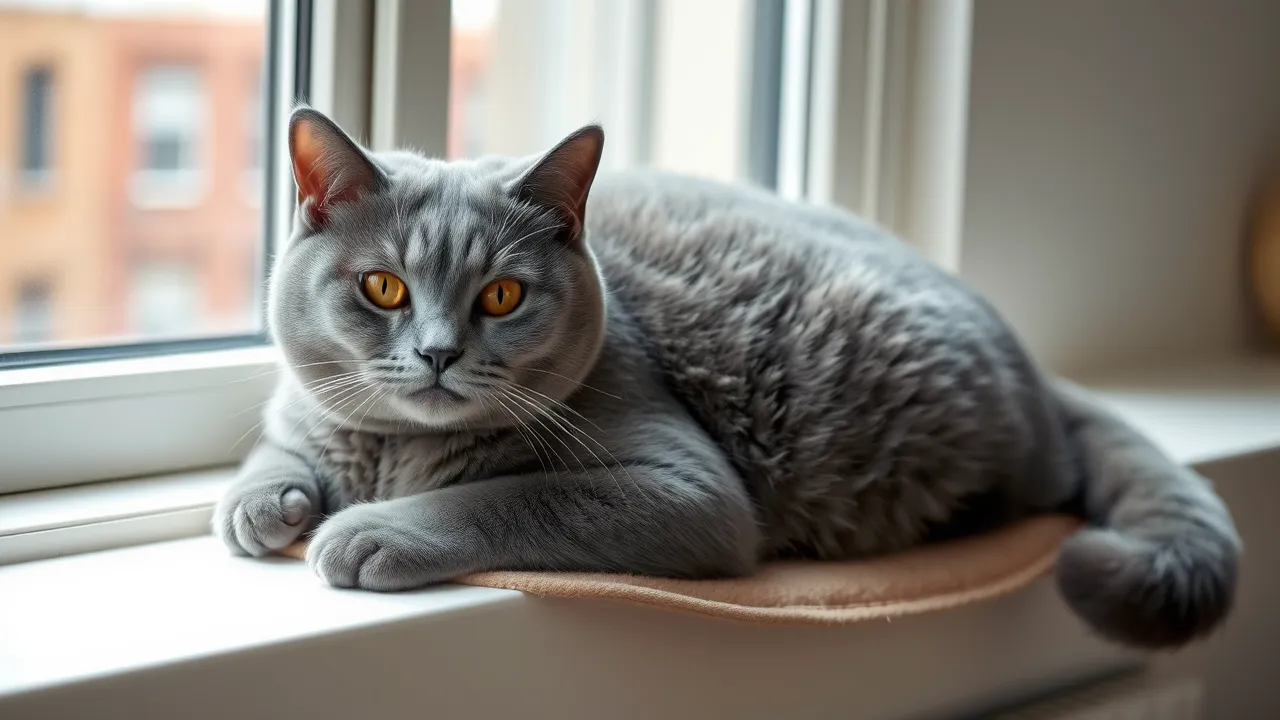
Where does the British Shorthair come from?
The British Shorthair grew out of Britain’s everyday street and farm cats, which probably descend from domestic cats brought over by the Romans in the first century AD. It became a formal pedigree breed in the late 1800s and was rebuilt after both World Wars.
The first cat show
On July 13, 1871, the first cat show in the United Kingdom was held at the Crystal Palace in London. According to the Governing Council of the Cat Fancy (GCCF), about 170 cats were shown, including “English Shorthair cats,” the forerunners of today’s breed. Best in Show went to a 14-year-old blue tabby shorthair female owned by Harrison Weir, the show’s organizer.
Weir was a natural history artist often called the “Father of the Cat Fancy.” He wrote the first standards that cats were judged against, admired the ordinary street cat, and used selective breeding to shape it into a distinct type. He also founded the National Cat Club in 1887.
War, near loss and rebuilding
British Shorthairs were common at early shows, but World War I hit the breed hard. Numbers recovered by the late 1930s, then dropped again during World War II. With so few cats left, breeders crossed their British cats with Russian Blues, Burmese and Chartreux to keep the gene pool healthy, and with Persians to restore the breed’s heavy bone and round type.
The Persian crosses had two lasting effects. They brought in the longhair gene, so longhaired kittens still turn up in some litters. They also explain why some British lines carried polycystic kidney disease, a condition first found in Persians (more on that in the health section).
Recognition around the world
The breed first reached the United States around the start of the 20th century, according to VCA. The Cat Fanciers’ Association (CFA) granted it championship status in May 1980. In the UK, the GCCF officially recognized the name “British Longhair” in February 2017 for the longhaired version, and gave it championship status in November 2021.

What does a British Shorthair look like?
Think “round.” A British Shorthair has a round head, round eyes, full cheeks, a short broad nose and a compact, powerful body on short, strong legs. The overall look is solid and teddy-bear-like.
Body and head
- A full, broad chest and a thick neck.
- Short, sturdy legs with rounded paws.
- A tail that is thick at the base and rounded at the tip.
- Large, round eyes that give a sweet, open expression.
- Mature males often develop heavy jowls.
The coat
The coat is the breed’s signature. Both the GCCF and VCA say the British has more fur per square inch than any other breed. It is short and plush, and breed experts describe it as “crisp” or “cracking,” because it breaks open over the curves of the body when the cat moves. VCA notes it feels surprisingly velvety.
Colors and patterns
Blue, a soft gray, is the classic color, and the GCCF says almost half of British registrations are solid (“self”) colors. But the breed comes in far more than gray. VCA counts more than 30 colors and patterns. The GCCF groups them like this:
| Group | What it looks like | Usual eye color |
|---|---|---|
| Self (solid) | One color, such as blue, black, white, lilac, chocolate, red or cream | Orange; whites can have blue, orange or odd eyes |
| Colorpointed | Darker face, ears, legs and tail, like a Siamese pattern | Blue |
| Tipped | Pale coat with colored hair tips (silver or golden) | Usually green |
| Tortoiseshell and bicolor | Mixed colors, with or without white | Varies |
| Tabby | Classic, spotted, mackerel or ticked tabby patterns | Varies |
Registries do not all accept the same colors, so if you plan to show a cat, check the standard of the registry you will use.
How big do British Shorthairs get?
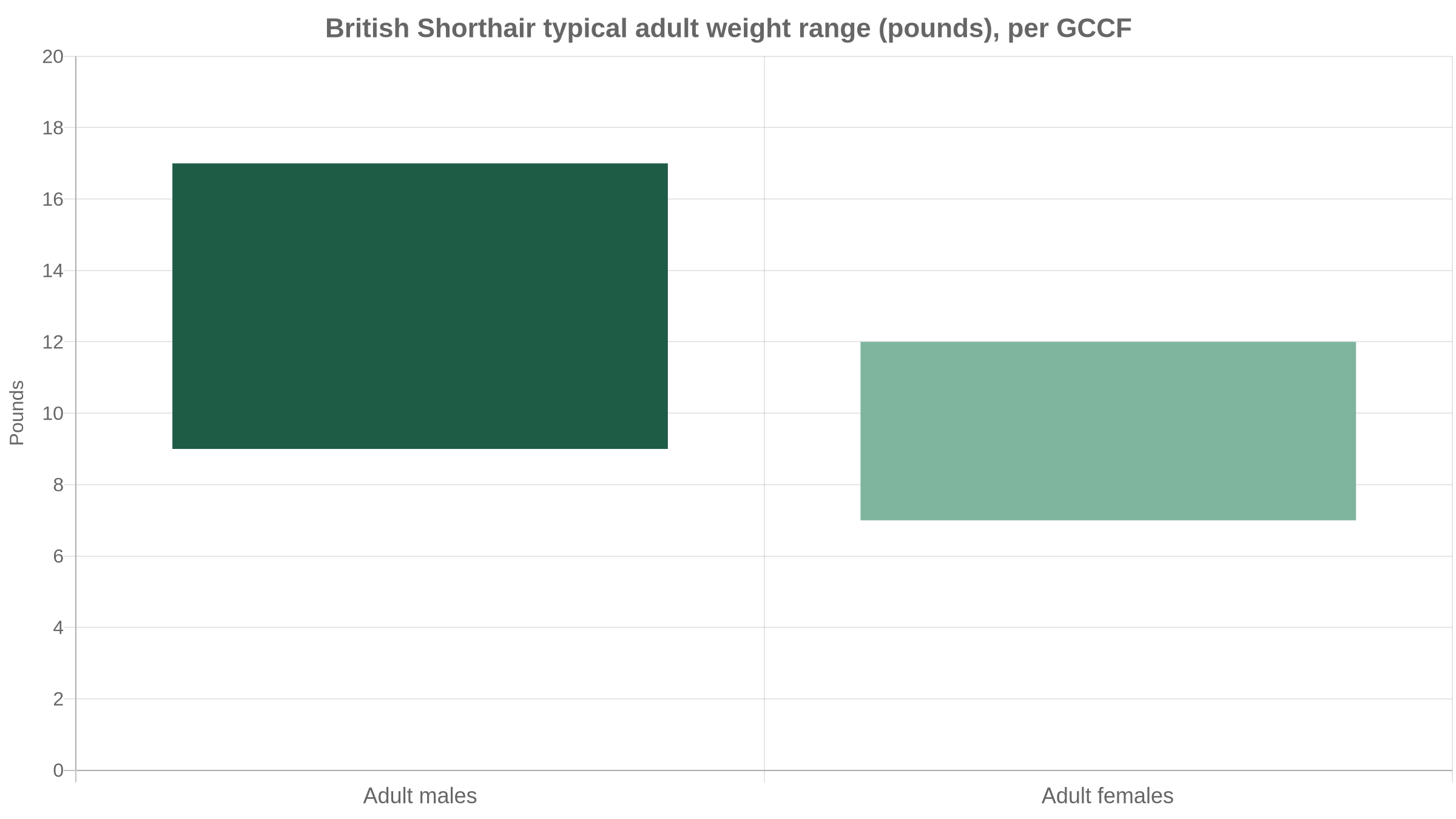
British Shorthairs are medium to large cats, and males are noticeably bigger than females. The GCCF lists males at about 9 to 17 pounds and females at about 7 to 12 pounds.
Sources do not fully agree. VCA lists a lower range of about 6 to 12 pounds, while other breed profiles give figures closer to the GCCF’s. The honest answer is that size varies by sex, bloodline and body condition. For a closer look at growth and adult size, see our short answer on how big British Shorthair cats get.
A slow-growing breed
Both the GCCF and VCA say the breed can take up to five years to reach full physical maturity. That means a two-year-old may still be filling out. It also means the scale alone can mislead you: a heavy cat is not automatically a fat cat, and a growing cat can look lean. Judge weight by body shape and feel, as explained in the feeding section.
What is the British Shorthair personality like?
British Shorthairs are calm, patient and affectionate in a low-key way. The GCCF describes them as “patient, tolerant and a bit lazy,” and both the GCCF and VCA note they are not a talkative breed.
Affectionate, but on their own terms
Most British cats bond closely with their people and like to be in the same room, keeping an eye on household routines. Many show affection by following you around or bumping their heads against you. If you have wondered what that bump means, our answer to why cats headbutt you explains it. Others knead blankets when relaxed, which is covered in why cats knead.
What they often dislike is being picked up. The GCCF says adult British cats prefer to keep all four paws on the ground. VCA adds that many enjoy hopping onto a lap but leave after a while, likely because their thick coat plus your body heat makes them too warm.
Playful kittens, mellow adults
Kittens are lively and comical. Adults tend to slow down, and VCA notes the breed is not known for speed or agility. This calm nature is a big part of the appeal, but it also means you may need to invite your cat to play rather than wait for it to ask.
Living needs: indoor life, play and other pets
British Shorthairs adapt well to most homes, including apartments, and can live happily indoors as long as they get daily play and mental exercise.
Indoors or outdoors?
The GCCF says the British is suitable as an indoor-only cat but needs suitable stimulation. Both the GCCF and VCA advise supervising them outdoors, because their trusting, docile nature can leave them vulnerable to traffic, predators and other mishaps.
Keeping a laid-back cat moving
- Hold two or three short play sessions a day with wand toys or toys your cat can stalk and pounce on.
- Use food puzzles or scatter part of a dry meal so your cat has to search for it.
- Offer sturdy, low-to-medium height climbing spots. This heavy breed prefers stable perches over tall, wobbly towers.
- Rotate toys weekly so old favorites feel new again.
- Try catnip if your cat responds to it. Our answer on whether catnip is bad for cats covers what to know.
Children and other pets
The GCCF describes the British as tolerant of other pets, including dogs and rabbits, and as forming strong bonds with people of all ages. Because adults often dislike being carried, teach children to sit on the floor and let the cat come to them. For more on mixed homes, see our list of cat breeds that get along with dogs.
Litter box basics
Like any cat, a British Shorthair needs a clean, roomy box. A large, heavy cat may need a bigger box than a kitten-sized one with low sides. For a simple routine, see how often to clean a litter box.
Grooming a British Shorthair
The British coat is short but very thick, so a weekly comb is enough most of the year, with more frequent sessions during spring and fall shedding. Baths are rarely needed.
Brushing and combing
VCA recommends running a comb through the coat at least weekly to keep it healthy and free of mats, and says basic metal combs or rubber curry combs work best. During seasonal shedding, more frequent sessions remove loose hair before your cat swallows it. That can help with hairballs, which we cover in depth in our guide to cat hairballs. If you need tools, our roundup of cat brushes and combs explains the main types.
Older cats need extra help. The GCCF notes that as a British cat ages and grooms itself less well, its coat may start to mat. Gentle combing becomes part of senior care.
Bathing
Unless you show your cat, the GCCF says the coat does not need regular shampooing. Most healthy cats keep themselves clean. Our short answer on how often you should bathe a cat explains when a bath actually makes sense.
A simple care schedule
| Task | How often | Why it matters for this breed |
|---|---|---|
| Comb the coat | Weekly; several times a week while shedding | Dense coat traps loose hair |
| Play sessions | Daily, in short bursts | Prevents weight gain in a low-energy breed |
| Weigh and body-check | Monthly | Catches slow weight gain early |
| Measure meals | Every meal | Slow metabolism; free feeding adds pounds |
| Check teeth and claws | Weekly | General health; dental disease is common in cats |
| Vet checkup | At least yearly; ask about heart listening | HCM can be silent for years |
Feeding a British Shorthair
Feed a complete, balanced cat food in measured portions. The breed’s biggest everyday risk is weight gain, so how much you feed matters as much as what you feed.
Kittens: stay on kitten food longer
Because British kittens mature slowly, the GCCF advises feeding kitten food for at least the first year while bone is being laid down. If you are unsure how kitten and adult diets differ, see whether you can feed kitten food to an adult cat.
Adults: watch the waistline
The GCCF says the British has a slow metabolism and warns owners not to let healthy muscle turn into excess fat. VCA advises measuring food portions for the same reason. Wet, dry or a mix can all work. Our guide to wet vs dry cat food compares them in detail.
The Cornell Feline Health Center calls obesity the most common nutritional disorder in pet cats and generally defines it as weighing 20 percent or more above normal. A Cornell lecturer estimated that about half of cats seen at vet clinics are overweight, and named “free feeding” (leaving dry food out all day) as a major cause. International Cat Care adds that neutering lowers a cat’s metabolic rate by about 20 percent, so neutered cats need less food.
How to tell if your cat is overweight
- You should be able to feel the ribs easily under a thin layer of fat.
- From above, you should see a slight waist behind the ribs.
- From the side, the belly should not hang or swing.
- Ask your vet to give a body condition score at each visit and to set a target weight.
If your cat needs to slim down, go slowly and work with your vet. International Cat Care notes that a gradual loss is ideal and that a very overweight cat may take up to a year to reach its target.
Treats and people food
Treats add calories fast in a small, slow-burning cat. Count them as part of the daily ration. Many owners ask about common kitchen foods: our short answers explain whether cats can eat tuna and whether cats can eat cheese. In both cases, small and occasional is the rule.
British Shorthair health problems and screening
British Shorthairs are generally sturdy, but they have a few known inherited risks: heart disease (HCM), kidney cysts (PKD), a high rate of blood type B, and a rare immune disease in kittens (ALPS). Good breeders test for most of these.
Hypertrophic cardiomyopathy (HCM)
HCM is the most common heart disease in cats. It makes the muscular walls of the heart thicken so the heart works less efficiently. The Cornell Feline Health Center lists the British Shorthair among the breeds where HCM is more common, along with the Maine Coon, Ragdoll, Sphynx, Chartreux and Persian.
A Danish study screened 329 British Shorthairs with heart ultrasound over four years. The authors reported a high rate of HCM, often starting early, with males much more likely to be affected. They strongly recommended ultrasound screening in the breed, especially in breeding cats.
Here is the tricky part: Cornell notes that many cats with HCM do not look ill. When signs do appear, they can include rapid or labored breathing, open-mouth breathing and lethargy. HCM can also cause blood clots that suddenly paralyze the back legs. On the bright side, Cornell says many cats diagnosed with HCM live normal or near-normal lifespans with appropriate care.
The GCCF says there is no DNA test for HCM in the British breed yet. Instead, responsible breeders keep affected cats out of breeding. Cornell calls heart ultrasound (echocardiography) the gold standard for diagnosis.
Polycystic kidney disease (PKD)
PKD is an inherited condition in which fluid-filled cysts form in the kidneys and grow over time, often leading to kidney failure. Cornell says it occurs mostly in Persians and occasionally in a few related breeds, including British Shorthairs, and that signs usually show up around age seven.
The good news: a DNA test exists. The GCCF says PKD, once a problem in the breed, is now under control thanks to widespread testing by responsible breeders. Signs of kidney trouble include drinking and urinating more. If you notice that, read why your cat may be drinking so much water and book a vet visit.
Blood type B
Cats have blood types A, B and the rare AB. Type A is most common in cats overall, but British Shorthairs have one of the highest rates of type B. Figures vary by country and study: one widely used US table lists about 36 percent of British Shorthairs as type B, and a veterinary review puts the type B rate in this and several other breeds anywhere from 10 to 60 percent.
This matters to pet owners because cats have no universal donor. Type B cats carry strong antibodies against type A blood, so a type B cat needs type B blood in a transfusion. Ask your vet to note your cat’s blood type before any planned surgery. For breeders, mismatched pairings can cause a dangerous condition in newborn kittens called neonatal isoerythrolysis, which is why Cornell experts recommend blood typing before breeding in this breed.
Autoimmune lymphoproliferative syndrome (ALPS)
ALPS is a rare, severe inherited immune disease found in British Shorthair kittens, in which immune cells build up in the lymph nodes. Langford Vets explains that a kitten must inherit two copies of the faulty gene to be affected, so carriers stay healthy but can pass it on. A DNA test is available, and since March 1, 2025, the GCCF has required a negative ALPS test for British Shorthairs imported from another registry for breeding.
Screening checklist
| Condition | Test | What to ask a breeder |
|---|---|---|
| PKD (kidneys) | DNA test | Are both parents tested negative? Can I see the results? |
| HCM (heart) | Heart ultrasound by a vet; no breed DNA test yet | When were the parents last scanned, and by whom? |
| ALPS (immune) | DNA test | Are the parents tested, and are any carriers? |
| Blood type | Blood typing | What is the kitten’s or parents’ blood type? |
| Weight | Body condition check | How are kittens fed, and what do the parents weigh? |
Everyday cat illnesses apply too. Sneezing and runny eyes, for example, are usually not breed-related; see why a cat sneezes a lot for the common causes.
How long do British Shorthairs live?
Breed organizations describe the British as long-lived, with the GCCF giving 14 to 20 years and VCA 15 to 20. Studies of UK vet records report lower average figures, so a realistic expectation is a wide range, with good weight control and early disease detection improving the odds.
A Royal Veterinary College VetCompass study of 4,009 cat deaths in England found a median lifespan of 11.8 years for British Shorthairs, compared with 14.0 years for crossbred cats. A later VetCompass life-table study, published in 2024, found that purebred status and a non-ideal body weight were both linked to shorter lives; news coverage of that study reported an average life expectancy of 9.6 years for the breed.
Why the gap? Breed clubs often describe what well-bred, well-kept cats can reach, while vet-record studies include every cat seen at a clinic, including those lost young to accidents or illness. Neither number is a promise for your cat. Once your British turns about 10, our senior cat care guide explains how care should change.
Cost of ownership
We don’t list prices here because they vary widely by country, breeder and year and change often. Instead, plan around these cost factors.
Up-front costs
- The kitten itself: pedigree kittens from health-testing breeders usually cost more than kittens from untested litters, because testing and good care cost the breeder money.
- Starter supplies: a sturdy carrier, a large litter box, a metal comb, scratching posts, stable perches and toys.
- First vet visits: vaccinations, microchipping and neutering if not already done.
Ongoing costs
- Food: quality complete food in measured amounts.
- Routine care: yearly checkups, vaccines, parasite control and dental care.
- Possible breed-related care: heart ultrasound if your vet hears a murmur, and kidney monitoring as your cat ages.
- Insurance or savings: consider pet insurance or an emergency fund, and check how any policy treats inherited conditions.
Breeder or adoption?
Both can work. Purebred British Shorthairs are uncommon in shelters, so most people buy from a breeder, but breed rescues and shelters are worth checking first.
Choosing a breeder
The CFA says that because breeders place their kittens carefully, a British Shorthair rarely needs rescuing from a shelter. The CFA and most breeders also disapprove of declawing. A good breeder should:
- Show you written health test results for the parents (PKD, ALPS, and heart scans).
- Let you meet the mother and see where kittens are raised.
- Register kittens with a recognized registry such as the GCCF, CFA or TICA.
- Keep kittens until they are old enough and vaccinated.
- Ask you questions about your home, and offer to take the cat back if things don’t work out.
- Give you a written contract and feeding instructions.
Adopting
Adult British Shorthairs sometimes need new homes when owners’ lives change, and breed clubs often help rehome them. An adult’s personality and size are already known, which suits many families. Ask for any vet records, and book a checkup soon after adoption.
Who is a British Shorthair right for?
A British Shorthair suits people who want a calm, quiet, affectionate companion that doesn’t demand constant attention, and who are willing to manage its weight.
A good match if you…
- Live in an apartment or want an indoor cat.
- Prefer a quiet cat that rarely meows.
- Have a calm household, older children, or a cat-friendly dog.
- Will play with your cat every day and measure its food.
- Want low-fuss grooming.
Maybe not the best match if you…
- Want a cat that loves being carried and cuddled for long periods.
- Want a highly athletic, acrobatic cat.
- Have a cat allergy. The breed is not hypoallergenic, and its dense coat still sheds.
Comparing breeds? The Ragdoll is another calm, large cat; see our Ragdoll breed guide and whether Ragdolls shed. The Maine Coon is bigger, longer-haired and more active.
When to call the vet
Because this breed is prone to heart disease that can stay hidden, breathing changes and sudden leg weakness are emergencies. Call your vet or an emergency clinic right away for any of the signs below.
Go now (emergency)
- Breathing fast or with effort, or breathing with the mouth open. Cornell cardiologist John Bonagura summed up the two red flags: “The animal can’t breathe or it can’t walk.”
- Sudden weakness, pain or paralysis in the back legs.
- Collapse or fainting.
- A male cat straining in the litter box with little or no urine.
- A young kitten that is weak, pale, not nursing, or has yellow gums.
Book an appointment soon
- Drinking or urinating more than usual.
- Losing weight, eating less, or vomiting more than occasionally.
- Less energy, hiding, or a messy, ungroomed coat.
- Weight gain you can’t control with portion changes.
- Swollen lymph nodes or a swollen belly in a kitten.
A tip from Cornell-affiliated experts: count your cat’s breathing while it sleeps. More than about 40 breaths per minute at rest can be a warning sign of heart trouble and is worth a call to your vet.
Quick answers
- How big do British Shorthair cats get? Medium to large; males are clearly heavier than females and keep growing for years.
- How often should you bathe a cat? Most healthy cats rarely or never need a routine bath.
- Why is my cat drinking so much water? Sudden heavy thirst can signal kidney disease or other illness; see a vet.
- Can you feed kitten food to an adult cat? It is richer than adult food, so it’s best kept for growing kittens.
- Can cats eat tuna? A little plain tuna as a rare treat is fine; not as a daily food.
- Can cats eat cheese? A tiny bite is usually harmless, but many adult cats don’t digest lactose well.
- Why does my cat headbutt me? It’s a friendly scent-marking habit that shows trust.
- How often should you clean a litter box? Scoop daily and wash the box about weekly.
Frequently asked questions
Are British Shorthairs good family cats?
Yes, for most families. The GCCF describes them as patient and tolerant, bonding with people of all ages and accepting other pets. Teach children to let the cat approach rather than picking it up.
Do British Shorthairs shed a lot?
They shed a moderate amount, with heavier shedding in spring and fall. Their very dense coat holds a lot of loose hair, so weekly combing and extra sessions during shedding seasons keep it under control.
Are British Shorthairs hypoallergenic?
No. No cat breed is free of allergens, and the British is not considered a good choice for people with cat allergies. Spend time with the breed before committing if allergies are a concern.
Do British Shorthairs like to be held?
Many adults don’t. The GCCF says they prefer all four paws on the ground. They usually show affection by staying near you, sitting beside you or briefly visiting your lap instead.
Are all British Shorthairs gray?
No. Blue (gray) is the best-known color, but the breed comes in solid colors, tabby, tortoiseshell, bicolor, colorpointed and tipped varieties. VCA counts more than 30 colors and patterns.
Is a British Shorthair the same as a British Blue?
“British Blue” is the popular name for a blue (gray) British Shorthair. It is a color within the breed, not a separate breed.
Can British Shorthairs live indoors only?
Yes. The GCCF says the breed suits indoor-only life as long as the cat gets enough stimulation. Daily play also helps prevent weight gain.
What health tests should a British Shorthair kitten’s parents have?
Ask for PKD and ALPS DNA results and recent heart ultrasound (HCM) screening for both parents, plus blood types. A good breeder will show you the paperwork without hesitation.
How we researched this guide
This guide is based on breed registry profiles (GCCF and CFA), veterinary sources (Cornell Feline Health Center, VCA, International Cat Care and Langford Vets) and published veterinary studies. Where sources disagree, such as on adult weight and lifespan, we show the range rather than picking one number.
Sources
- British, The Governing Council of the Cat Fancy (GCCF)
- British Shorthair, VCA Canada Animal Hospitals
- Learn more about the British Shorthair (history), Cat Fanciers’ Association
- Learn more about the British Shorthair (breed profile), Cat Fanciers’ Association
- Hypertrophic Cardiomyopathy, Cornell Feline Health Center
- Cardiomyopathy, Cornell Feline Health Center
- Diagnosis: Heart Disease, Cornell Feline Health Center
- Polycystic Kidney Disease, Cornell Feline Health Center
- Obesity, Cornell Feline Health Center
- Heart Disease in Your Cat, CatWatch (Cornell)
- Neonatal Isoerythrolysis, CatWatch (Cornell)
- Obesity in cats, International Cat Care
- British Shorthair Autoimmune Lymphoproliferative Syndrome (ALPS), Langford Vets
- Feline Update: Blood Groups, Langford Vets and Zoetis
- Canine and Feline Blood Types and Blood Compatibility Issues, VIN
- Feline Neonatal Isoerythrolysis and the Importance of Feline Blood Types, Veterinary Medicine International
- Prevalence of Hypertrophic Cardiomyopathy in a Cohort of British Shorthair Cats in Denmark (abstract)
- How long do our cats live?, Royal Veterinary College VetCompass
- Life tables of annual life expectancy and risk factors for mortality in cats in the UK, Journal of Feline Medicine and Surgery
- Cat lifespans 2026, The Scotsman
This article is general information and is not a substitute for advice from your veterinarian.