


The Ragdoll is a big, blue-eyed, semi-longhaired cat known for a calm and people-loving nature. This guide covers where the breed came from, how large it gets, what it is like to live with, and the grooming, feeding and health screening it needs. The most important takeaway: a Ragdoll is an easygoing companion, but it grows slowly, gains weight easily, and should come from parents tested for the breed’s known heart gene.
Key takeaways
- Ragdolls were developed in Riverside, California, in the 1960s by breeder Ann Baker from a white longhaired cat named Josephine.
- They are among the largest pet cat breeds. Registries list adult males at roughly 12 to 20 pounds and females at about 8 to 15 pounds.
- They mature slowly: the Cat Fanciers’ Association (CFA) says full coat color arrives at about two years and full size at about four.
- Every Ragdoll is a blue-eyed pointed cat. The main patterns are colorpoint, mitted and bicolor, in six point colors.
- The silky coat has little undercoat, so combing once or twice a week is usually enough, with extra sessions when the cat is shedding.
- Hypertrophic cardiomyopathy (HCM), a heart muscle disease, is the main inherited concern. A DNA test exists for the one known Ragdoll mutation.
- Ragdolls love food and are not very active, so measured meals and daily play matter.
In this guide
- Ragdoll at a glance
- Where the Ragdoll came from
- What a Ragdoll looks like
- How big Ragdolls get
- Personality and temperament
- Living needs: home, play and safety
- Grooming
- Feeding
- Health conditions and screening
- When to call the vet
- Cost, adoption and breeders
- Who the Ragdoll suits
- Frequently asked questions and quick answers
Ragdoll at a glance
The Ragdoll is a large, laid-back, semi-longhaired cat with blue eyes and a pointed coat. The table below pulls together the basic facts. Where sources give different numbers, we show the range and name the source.
| Trait | What the sources say |
|---|---|
| Origin | Riverside, California, United States, 1960s |
| Size | Large. Neutered males about 12 to 20 lb, females about 8 to 15 lb (GCCF). The CFA notes mature males can reach or pass 20 lb. |
| Coat | Semi-long, silky, with little woolly undercoat |
| Eyes | Blue |
| Patterns | Colorpoint, mitted, bicolor (the CFA also lists van) |
| Point colors | Seal, blue, chocolate, lilac, red, cream, plus lynx (tabby) and tortie versions |
| Temperament | Docile, placid and affectionate (CFA) |
| Grooming | Comb once or twice a week; more when shedding |
| Lifespan | Sources differ: 11 to 13 years on average (PDSA), 12 to 17 years (GCCF, Royal Canin) |
| Full maturity | About four years |
| Main inherited concern | Hypertrophic cardiomyopathy (DNA test available) |
Where did the Ragdoll come from?
The Ragdoll is a young, American-made breed. It was developed in the 1960s by Ann Baker, a breeder in Riverside, California, starting from a white domestic longhaired cat called Josephine.
Josephine and the first Ragdolls
According to the CFA, Josephine was a white domestic longhair that carried the colorpoint gene, and Baker felt her kittens had unusually sweet temperaments. Baker bred Josephine’s offspring to other longhaired cats and kept the ones with the look and personality she wanted.
The Governing Council of the Cat Fancy (GCCF) in the UK names the key early cats. Daddy Warbucks was a seal mitted son of Josephine with a white blaze. Buckwheat was a black daughter of Josephine, and Fugianna was a seal bicolor daughter sired by Daddy Warbucks. Kittens from Buckwheat and Daddy Warbucks, named Kyoto and Tiki, were among the very first cats recorded as Ragdolls.
Sources do not fully agree on the dates. The GCCF places the first registered Ragdolls in 1965. The Ragdoll Historical Society says the first kittens were called Ragdolls in 1965, and that Baker registered her first four Ragdolls (Daddy Warbucks, Tiki, Kyoto and Fugianna) with a US registry on December 30, 1966. The society itself describes the breed’s beginnings as clouded in mystery.
A breed with its own registry
Baker took an unusual path. She trademarked the Ragdoll name and, instead of joining an existing cat registry, set up her own: the International Ragdoll Cat Association (IRCA). Breeders who wanted Ragdolls had to follow her rules and could not register their cats elsewhere, the GCCF explains.
By the mid-1970s, other breeders wanted wider recognition. A group led by Denny and Laura Dayton broke away and wrote the Ragdoll standard that the major registries use today. A second group that left IRCA went on to develop a related breed, the Ragamuffin.
Recognition and popularity
The International Cat Association (TICA) accepted the Ragdoll for championship competition in 1979. The CFA accepted the breed for registration in 1993 and moved it up to championship status in 2000. In the UK, Ragdolls arrived in 1981 and were recognized by the GCCF nine years later.
The climb since then has been steep. The CFA now describes the Ragdoll as the most popular cat breed in the world, based on its own registration figures.
What does a Ragdoll look like?
A Ragdoll is a large, long-bodied cat with a silky semi-long coat, darker “points” on the face, ears, legs and tail, and blue eyes. Nothing about the breed should look extreme: the CFA standard asks for a balanced cat.
Head, eyes and body
- Head: a broad, modified wedge with a flat area between the ears, a gently curving profile and a strong chin.
- Eyes: large, oval and vivid blue. In the CFA standard, any other eye color is a disqualifying fault.
- Ears: medium-sized, set wide, with rounded tips and a slight forward tilt.
- Body: long, rectangular and heavily boned, with a full chest. The standard wants a firm, muscular cat, not a fat one, though a modest fat pad on the lower belly is accepted.
- Legs and paws: sturdy legs, with the hind legs a little longer than the front, and large round paws with tufts of fur.
- Tail: long and plumed.
The coat
The coat is made mostly of guard hairs with very little woolly undercoat. That is why it lies flat, feels silky and tangles less than the coats of many longhaired breeds. It is shorter on the face and shoulders and longer around the neck (the ruff), on the back legs (the “britches”) and toward the tail.
Patterns: where the white goes
Every Ragdoll is a pointed cat, which means the body is lighter than the face, ears, legs and tail. The pattern name tells you how much white covers those points. The GCCF recognizes three patterns. The CFA lists a fourth, the van.
| Pattern | What it looks like | Telltale sign |
|---|---|---|
| Colorpoint | Dark mask, ears, legs, feet and tail with no white anywhere | Nose and paw pads match the point color |
| Mitted | Pointed, with white front mittens, white back legs up to the hocks, and a white belly stripe | A white chin; some have a white blaze on the nose |
| Bicolor | Dark ears, tail and mask, with a white upside-down “V” on the face and white chest, belly and legs | Pink nose and the inverted V |
| Van (CFA) | Mostly white, with color limited to the ears, tail and upper mask | A nearly all-white body |
Colors
The six point colors are seal (deep brown), blue (blue-gray), chocolate, lilac, red and cream. Each can also come as lynx, which adds tabby striping to the points, as tortie, which mottles the points with red or cream, or as a mix of the two. Put pattern and color together and you get names such as “seal bicolor” or “blue lynx mitted.”
Ragdoll kittens are born white. The GCCF notes that point color starts to show a few days after birth and keeps deepening as the cat grows. Adults often darken further with age.
How big do Ragdolls get?
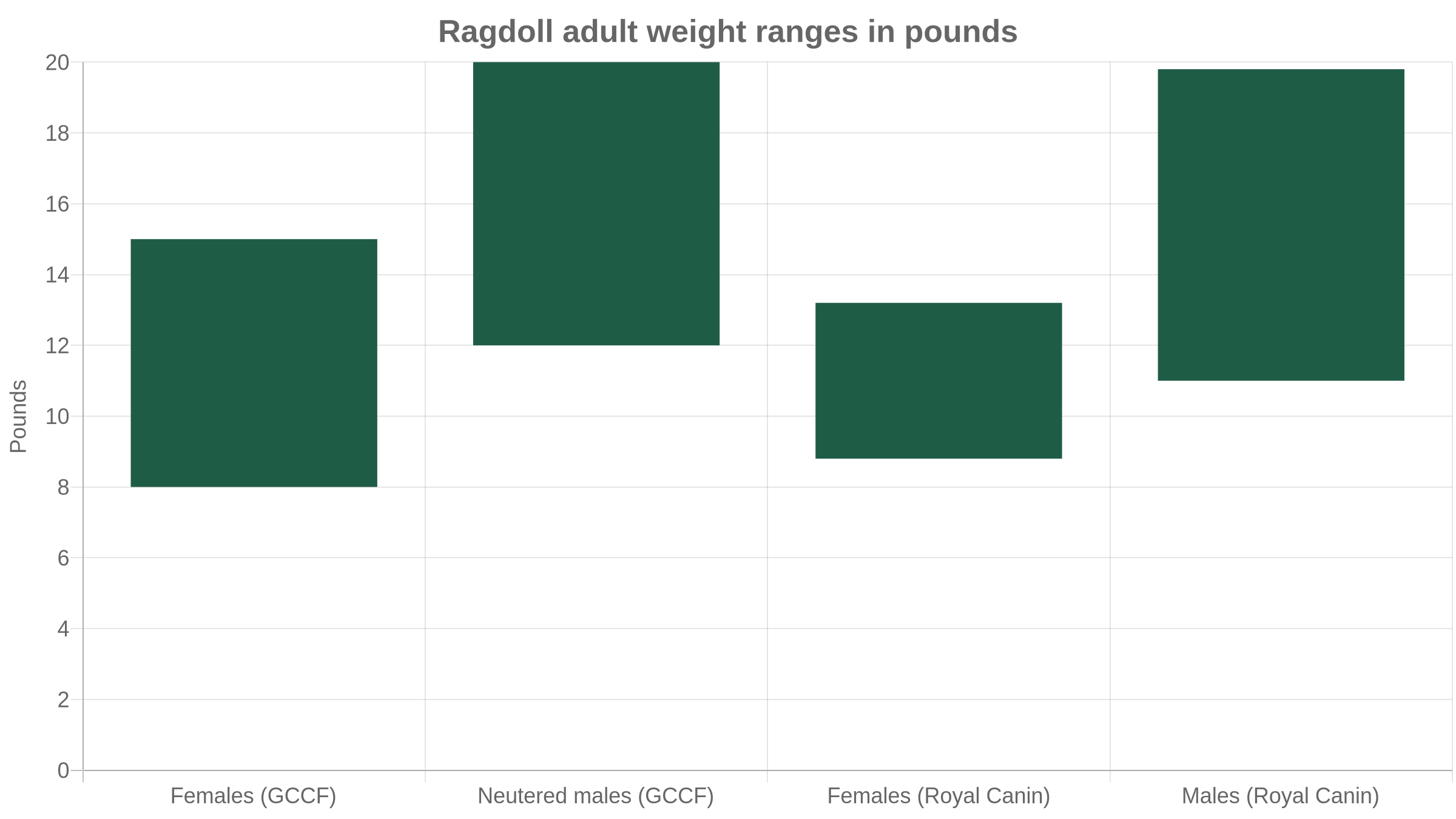
Ragdolls are one of the largest pet cat breeds, and males are clearly bigger than females. Expect an adult male somewhere between about 12 and 20 pounds and a female between about 8 and 15 pounds.
The exact figures vary by source. The GCCF lists neutered males at 12 to 20 pounds and females at around 8 to 15 pounds. Royal Canin’s UK breed page gives 5 to 9 kg for males and 4 to 6 kg for females, which is about 11 to 20 pounds and 9 to 13 pounds. The CFA says it is not unusual for a mature male to reach or pass 20 pounds. The UK vet charity PDSA puts the breed’s average weight at 5.5 kg, or about 12 pounds.
A slow-growing cat
Ragdolls take their time. According to the CFA, they reach full coat color at about two years and full size and weight at about four. A one-year-old Ragdoll may look grown but is still filling out, so do not judge a young cat’s final size or color too early.

If you are comparing large breeds, our Maine Coon breed profile covers the other well-known gentle giant.
What is a Ragdoll’s personality like?
Ragdolls are gentle, calm and strongly attached to their people. The CFA sums up the breed as docile, placid and affectionate, and describes cats that are loving without being demanding.
The “puppy cat”
Many Ragdolls act a little like dogs. VCA Animal Hospitals notes they are often called “puppy cats” because they trail their favorite people from room to room and stay playful as adults. The CFA adds that they tend to greet owners at the door, can learn to fetch and to come when called, and often sleep on the bed.
They are quiet cats. The CFA says they are not talkative but may offer a soft mew now and then, and the PDSA agrees that they are not very chatty. Expect lots of lap time too. Like most cats, many Ragdolls will “make biscuits” on a blanket or on you; our article on why cats knead explains that habit.
Do Ragdolls really go limp when you pick them up?
Some do relax in your arms, but it is not a rule. The name comes from Baker’s claim that Josephine went limp when held. The CFA says this trait is not typical of most Ragdolls today. The GCCF is blunter, dismissing the floppiness as “pure hype.”
One old myth needs correcting. Early marketing claimed Ragdolls feel less pain than other cats. The GCCF calls that idea dangerous and states that Ragdolls respond physically like any other cat. Handle a Ragdoll as carefully as you would any cat, and always support its heavy body with both arms.
Children and other pets
Because Ragdolls are rarely aggressive, the CFA considers them excellent pets for children and good with other animals. VCA says they fit well in multi-pet homes, including homes with dogs. There is a catch: their trusting nature means a rougher resident cat or dog may not be as polite in return, so the CFA advises making introductions with extra care. If you already have a dog, see our list of cat breeds that get along with dogs.
Remember that breed describes a tendency, not a guarantee. The GCCF points out that how any kitten is raised and handled has a huge effect on how sociable it becomes.
Living needs: home, play and safety
Ragdolls adapt to most homes, including small ones, as long as they have company, daily play and a safe indoor life. The CFA notes they do not need a lot of living space.
Indoors is safest
VCA describes Ragdolls as overly trusting cats with little instinct to fight, and recommends keeping them indoors or supervising them outside. The CFA also advises an indoor life. Before your cat arrives, work through our tips for cat-proofing your home.
Company
This is a breed that wants to be near you. The PDSA says a Ragdoll is unlikely to be far from its owner in the house. A Ragdoll may be a poor match for a home that stands empty most of the day unless it has another friendly pet for company.
Play and exercise
Ragdolls are moderately active. The CFA says they enjoy play sessions but do not insist on them, and the PDSA notes they are not usually highly active. That is exactly why you should start the games yourself. The GCCF calls exercise through play essential for keeping the breed fit.
- Offer short play sessions every day with wand toys, balls or a game of fetch.
- Rotate toys so they stay interesting. Many cats enjoy catnip toys; if you are unsure about it, read is catnip bad for your cat?
- Provide scratching posts. The CFA lists acceptable scratching surfaces as a basic need and disapproves of declawing.
- Think low and sturdy. VCA notes Ragdolls tend to prefer the floor and low spots over high shelves, so choose stable furniture built for a heavy cat. Our guide to cat trees for multiple cats looks at larger models.
Litter box basics
A long coat with fluffy britches picks up mess more easily than a short one, so a clean box matters. Our guide on how often you should clean a cat litter box gives a simple schedule: scoop at least once a day and wash the whole box about once a week. If a kitten starts nibbling its litter, see why is my cat eating cat litter?
Setting up for a first cat? Our new cat supplies shopping guide lists the basics.
How much grooming does a Ragdoll need?
Less than the coat suggests. Combing once or twice a week is the usual advice, with more during heavy shedding. Because the coat has little undercoat, it mats less than many long coats, but it is not maintenance-free.
Sources vary a little here. The CFA recommends combing at least once or twice a week with a steel comb to find loose hair and tangles. The PDSA says weekly grooming is the minimum. VCA goes as far as saying the coat sheds minimally and does not mat. The GCCF takes the more cautious view: Ragdolls do molt, need extra grooming at those times, and will mat if the coat is left unattended. The safe reading is to comb weekly at the very least and check for tangles often.
Where tangles start
The PDSA singles out two trouble spots: under the front legs and around the neck. Check those areas every time you comb. If you do find a knot, our guide to de-matting a cat walks through the gentle way to remove it, and our roundup of cat brushes and combs covers the tools.
| Task | How often | Notes |
|---|---|---|
| Comb the coat | Once or twice a week (CFA); weekly minimum (PDSA) | A steel comb reaches down to the skin |
| Check underarms and neck | Every grooming session | The areas the PDSA flags for tangles |
| Extra combing | During seasonal shedding | The CFA notes shedding rises with the change of seasons |
| Bath | Only if needed | The CFA suggests asking your breeder about products and technique |
| Nails and teeth | As part of regular home care | Ask your vet what routine suits your cat |
Regular combing also removes loose hair before your cat swallows it. An occasional hairball is common in cats, but frequent ones are worth a vet visit; our cat hairballs guide covers causes and warning signs. For the rest of the routine, see how to trim your cat’s nails and how to brush your cat’s teeth.
What should you feed a Ragdoll?
Feed a complete cat food in measured portions and keep a close eye on weight. The breed’s main feeding risk is not a special deficiency. It is overeating.
Why portion control matters
The CFA says Ragdolls are known for their love of food and may be at risk of obesity, and it advises owners to monitor portion sizes. VCA makes the same point from the other direction: these cats are prone to obesity because they are not very active. Royal Canin adds that, given their heavy build, Ragdolls can have joint and bone problems, which extra weight will not help.
Size makes weight harder to judge by eye. A healthy Ragdoll is large and may have a small belly pad, and the fluffy coat hides its shape. The breed standard’s phrase is a useful guide: firm and muscular, not fat. Ask your vet to show you how to check body condition with your hands, and weigh your cat regularly.
Feeding a slow-growing kitten
Because Ragdolls keep growing until about age four, owners often ask how long to stay on kitten food. There is no single answer for every cat, so plan the switch with your vet based on your cat’s growth and body condition. For background on how the two diets differ, read can you feed kitten food to an adult cat?
Treats and table food
For a food-loving breed, treats add up fast. Keep them small and occasional.
- Fish is a common request. Our article can cats eat tuna? explains why a little plain tuna is fine as an occasional treat but never as a daily food.
- Before sharing from your plate, check what human foods are safe for your cat.
- In a home with dogs, a Ragdoll may sample the dog’s bowl. See can cats eat dog food? for why that should not become a habit.
If you are choosing a food, our guide on how to choose healthy food for your cat is a good next step. Any cat with a diagnosed heart or kidney problem should eat only what its own vet recommends.
Ragdoll health conditions and screening
Ragdolls are fairly healthy overall, but two inherited conditions come up most often: hypertrophic cardiomyopathy (HCM) and polycystic kidney disease (PKD). The PDSA lists both as breed-related problems. The CFA credits the breed’s mixed genetic background for its general health and names HCM as the one hereditary issue found in it.
Hypertrophic cardiomyopathy (HCM)
HCM is the most common heart disease in cats, according to the Cornell Feline Health Center. The muscular walls of the heart thicken, so the heart pumps less efficiently. Cornell lists the Ragdoll among the breeds where HCM is more common, along with the Maine Coon, British Shorthair, Persian and Sphynx.
Many cats with HCM do not look ill. When signs appear, Cornell describes labored or rapid breathing, open-mouthed breathing and lethargy, which happen when fluid builds up in or around the lungs. HCM can also cause blood clots. A clot most often lodges where it cuts off blood to the back legs, causing sudden hind-leg paralysis and pain. Sudden death is possible, though Cornell calls it relatively rare.
There is no known cure, but Cornell notes that many cats diagnosed with HCM live normal or near-normal lifespans, and that treatment can improve quality of life. The standard way to diagnose it is an echocardiogram, an ultrasound scan of the heart.
The Ragdoll HCM gene test
In Ragdolls, one specific mutation is linked to HCM. It sits in a gene called MYBPC3 and is known as R820W. The UC Davis Veterinary Genetics Laboratory and Langford Vets in the UK both offer a DNA test for it, done from a simple cheek swab.

What the results mean, according to those two labs:
- Two copies: high risk. UC Davis says these cats tend to develop severe signs, usually between one and two years of age. Langford reports that in one study, more than half of Ragdolls with two copies did not survive to five years.
- One copy: the labs word this differently. UC Davis says recent studies show these cats are unlikely to show signs and may live a normal lifespan. Langford says cats with one or two copies are at greater risk of heart disease. Either way, the cat can pass the mutation to half of its kittens.
- No copies: the cat does not have the known mutation. Langford cautions that such a cat could still develop heart disease from other causes not yet identified.
Langford cites studies suggesting about 13% of Ragdolls carry the mutation. Since February 24, 2016, the GCCF has required every Ragdoll registered for breeding to be tested for it. For buyers, the practical step is simple: ask the breeder for copies of both parents’ test results. A clear gene test does not replace a vet exam, and Langford suggests a heart scan for cats that test positive.
Polycystic kidney disease (PKD)
The PDSA lists PKD as a possible health problem in Ragdolls. Cysts are present in the kidneys from birth and slowly grow until the kidneys can no longer work normally, which leads to kidney failure. A genetic test is available for this disease as well, so it is fair to ask a breeder about it.
Weight, joints and blood type
Obesity is the everyday health risk for this breed, as covered in the feeding section. Royal Canin also flags joint and bone problems linked to the Ragdoll’s size. One more point matters mainly to breeders: the GCCF notes a blood group known as B3 has been identified in Ragdolls and strongly recommends blood typing so that breeding cats are compatible.
How long do Ragdolls live?
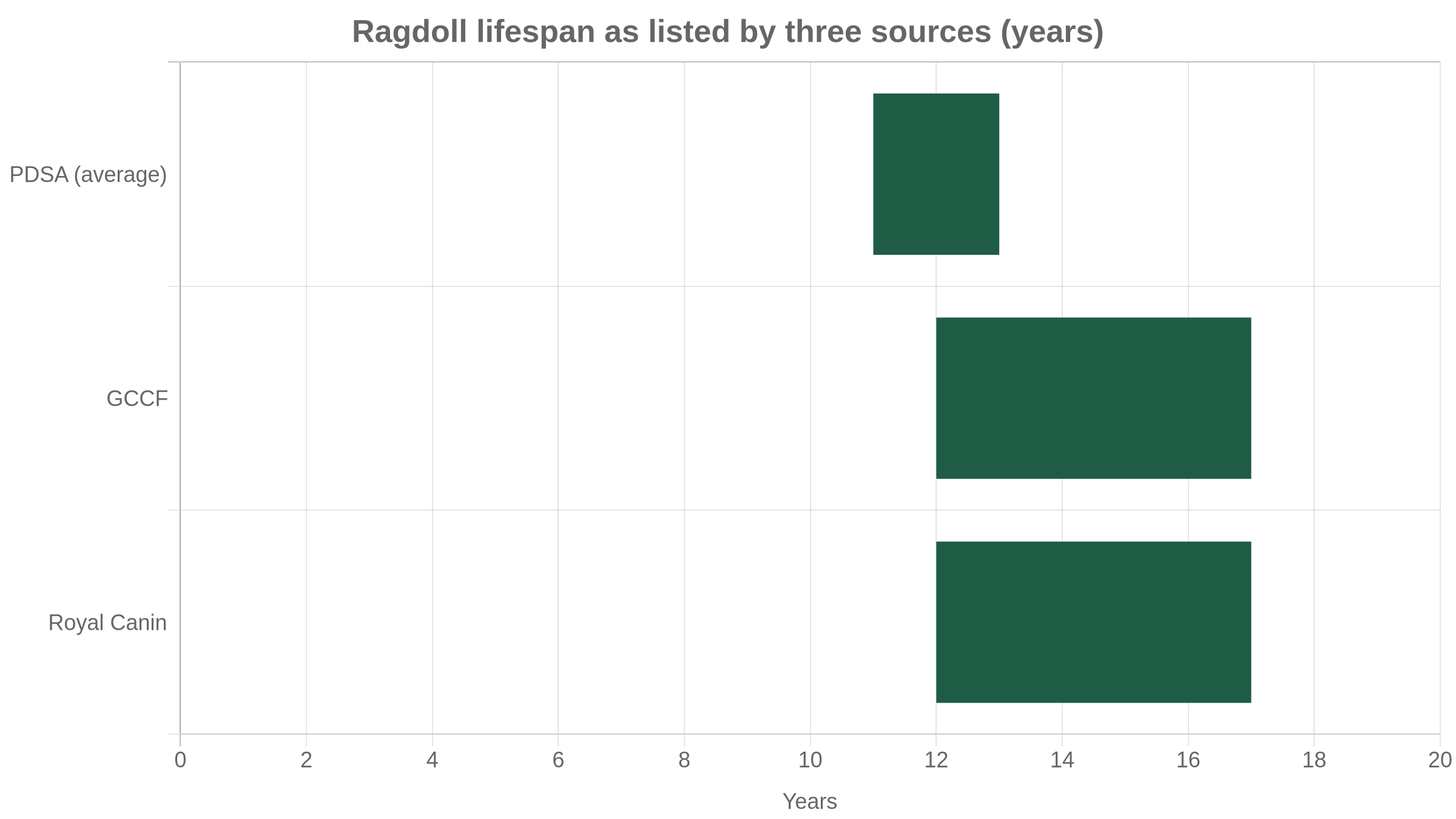
Sources disagree. The PDSA gives an average lifespan of 11 to 13 years. The GCCF lists 12 to 17 years and a life expectancy of around 15. Royal Canin also says 12 to 17 years. Some published figures run higher still, so treat any single number with caution. Good weight control, indoor living and regular vet checks are the factors you can control.
When to call the vet
Call your vet promptly for any change in breathing, movement, appetite or energy, and treat breathing trouble or sudden back-leg weakness as an emergency. Cats hide illness well, and Ragdolls are calm by nature, so small changes are easy to miss.
Go to a vet or emergency clinic right away if your cat:
- Struggles to breathe, breathes fast while resting, or breathes with an open mouth.
- Suddenly cannot use its back legs, or cries out in pain.
- Collapses or faints.
These are the signs Cornell’s heart specialists link to advanced heart disease. Cornell notes that cats in heart failure usually have a resting breathing rate above about 35 breaths per minute.
Book an appointment soon if you notice:
- Unusual tiredness, weakness or less interest in play.
- Eating less, or losing weight.
- A coat that suddenly looks unkempt, which can mean the cat has stopped grooming itself.
- Steady weight gain or trouble jumping.
- Frequent hairballs or vomiting.
- Mats that sit tight against the skin and that you cannot comb out gently.
For a wider checklist, see our signs that your cat may be sick. Even a healthy Ragdoll needs routine vet checkups. Ask your vet whether heart screening makes sense for your cat, especially if you do not know the parents’ gene test results.
Cost, adoption and breeders
A Ragdoll’s purchase price is the small part of the bill. Food, litter, insurance and vet care over a decade or more cost far more, and where you get your cat affects its health for life.
What ownership costs
We found one published estimate from a veterinary charity. The PDSA puts the lifetime cost of a Ragdoll at £12,500 to £14,700. That UK figure covers essentials such as food, litter, grooming tools, preventive care, vaccinations, neutering, toys, a carrier and insurance. It leaves out the purchase price and any vet treatment that insurance does not cover. Costs differ by country and change over time, so use it only as a rough guide.
The main cost factors for this breed are:
- Food: a large cat eats more than a small one.
- Insurance and vet care: the PDSA notes Ragdolls are prone to certain conditions, and heart scans cost extra.
- Health testing: the DNA test itself is inexpensive. UC Davis listed its Ragdoll HCM test at $44 per cat when we checked; prices change.
- Grooming tools and sturdy gear: a good comb, a solid carrier and furniture built for a heavy cat.
- Purchase or adoption fee: this varies widely with location, pedigree and breeder, so we do not quote a figure.
Buying from a breeder
The CFA suggests visiting a cat show to meet breeders and see adult Ragdolls in person. It adds that finding a kitten is not usually hard, but you may wait for a particular color or sex. When you talk to a breeder:
- Ask for copies of both parents’ HCM gene test results. The GCCF tells buyers to do exactly this.
- Ask about the health history of the parents and grandparents, as the PDSA recommends, including heart and kidney disease.
- Ask which registry the kittens are registered with.
- Meet the kitten with its mother and watch how it has been handled. Early, gentle handling shapes temperament.
- Walk away from any seller who will not share test results or let you see where the kittens are raised.
Adopting a Ragdoll
Adult Ragdolls and Ragdoll mixes do need new homes from time to time. The GCCF points would-be owners to rescue and rehoming routes, including rehoming run by breed clubs. An adult has one clear advantage: its size, coat and personality are already settled, so there is less guesswork. The trade-off is that you may not get health test results for the parents, so discuss screening with your vet.
Who is the Ragdoll right for?
The Ragdoll suits people who want a calm, affectionate indoor cat and are home enough to give it company. It is a weaker fit for anyone wanting an independent, outdoor or low-contact pet.
A Ragdoll may suit you if:
- You want a cat that follows you around and likes laps.
- You have children or other gentle pets.
- You live in an apartment or a house and plan to keep your cat indoors.
- You are happy to comb a coat every week and play every day.
- You prefer a quiet cat.
Think twice if:
- Nobody is home for most of the day and there is no other pet for company.
- You want a cat that roams outdoors on its own.
- You dislike grooming or cat hair on furniture.
- You are not ready to measure meals and manage weight.
- You cannot budget for insurance or possible heart screening.
How we researched this guide
This guide is based on published information from cat registries (CFA, GCCF), veterinary organizations and schools (Cornell Feline Health Center, PDSA, VCA Animal Hospitals), and genetics laboratories (UC Davis, Langford Vets). It is not based on hands-on testing or first-hand experience with individual cats. Where sources disagreed, we gave the range and named each source. All sources are listed at the end.
Frequently asked questions
Are Ragdolls good with children and dogs?
Usually, yes. The CFA calls them excellent pets for children, and VCA says they fit well in homes with dogs. Introduce them carefully, because a trusting Ragdoll may not defend itself against a rough pet.
Do Ragdolls shed?
Yes. The CFA says they shed like all cats, mostly with the change of seasons. Because the coat has little undercoat, shedding and matting are lighter than in many longhaired breeds, and weekly combing keeps it under control.
Do all Ragdolls have blue eyes?
Under the breed standard, yes. The CFA standard calls for vivid blue eyes and disqualifies any other eye color in the show ring. A Ragdoll-type cat with different eye color may be a mix or may not meet the standard.
When is a Ragdoll fully grown?
At about four years old. The CFA says Ragdolls reach full coat color at around two years and full size and weight at around four. The GCCF gives the same age for full maturity.
Can Ragdolls go outside?
It is safest to keep them indoors. VCA describes the breed as overly trusting and lacking a fighting instinct, and recommends indoor living or supervised outdoor time only.
What is the difference between a Ragdoll and a Ragamuffin?
They share roots. The Ragamuffin was developed by a group of breeders who left Ann Baker’s IRCA registry. It is now a separate breed with its own standard, while the Ragdoll is always a blue-eyed pointed cat.
Should a pet Ragdoll have the HCM gene test?
If both parents tested clear, your kitten cannot have inherited the known mutation from them. If you do not know the parents’ results, the cheek-swab test can tell you whether your cat has it. Talk through the result with your vet, since a clear test does not rule out heart disease from other causes.
Quick answers
Short answers to related questions, each with a full article on Catish.
- Can cats eat tuna? A little plain canned tuna is fine as an occasional treat, but never as a daily food.
- Why do cats knead? It is a normal comfort behavior left over from kittenhood.
- How often should you clean a cat litter box? Scoop at least once a day and wash the whole box about once a week.
- Can you feed kitten food to an adult cat? Kitten and adult foods are built for different needs; the article explains what that means.
- Is catnip bad for your cat? The short answer is no, with a few details to keep in mind.
- Can cats eat dog food? It can fill a one-night gap, but it should not become a cat’s regular diet.
- Why is my cat eating cat litter? It is more common than you might think, especially during litter training, and worth stopping early.
- What human foods are safe for your cat? Some are fine in small amounts; check the list before you share.
Sources
- Ragdoll breed profile and breed standard, The Cat Fanciers’ Association
- About the Ragdoll, The Cat Fanciers’ Association
- Ragdoll, The Governing Council of the Cat Fancy
- Ragdoll breed information, PDSA
- Ragdoll, VCA Animal Hospitals
- Hypertrophic Cardiomyopathy, Cornell Feline Health Center
- Cardiomyopathy, Cornell Feline Health Center
- Diagnosis: Heart Disease, Cornell Feline Health Center
- Pets Get Heart Disease Too, Cornell Feline Health Center
- Hypertrophic Cardiomyopathy (HCM) in Ragdolls, UC Davis Veterinary Genetics Laboratory
- Ragdoll Hypertrophic Cardiomyopathy (RD-HCM), Langford Vets
- Ragdoll History: The Beginning, Ragdoll Historical Society
- Ragdoll breed facts and characteristics, Royal Canin UK
- Ragdoll, Royal Canin breed library
- Let’s talk Ragdolls, Royal Canin
- Heart Diseases Often Undetected Signs, CatWatch (Cornell University College of Veterinary Medicine)
- Ragdoll Cat: Characteristics, Personality, and Breed Information, Cats.com
This article is general information and is not a substitute for advice from your veterinarian.