

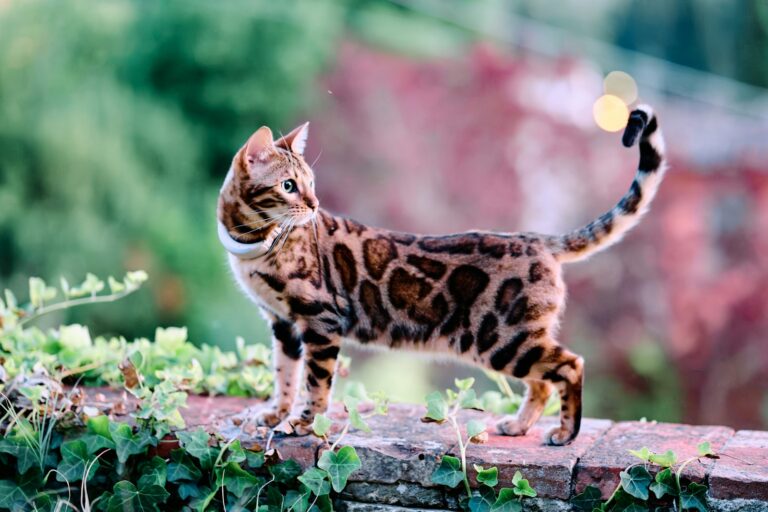
This guide covers where the Bengal came from, how big it gets, what it is like to live with, how to care for it, which health tests matter, and the laws that can affect ownership. The single most important takeaway: a Bengal is a brilliant pet for a home that can give it hours of play and attention every day, and a frustrating one for a home that cannot.
Key takeaways
- Bengals descend from crosses between domestic cats and the wild Asian leopard cat, but pet Bengals today are bred Bengal to Bengal.
- Most adults weigh roughly 6 to 15 pounds, with males larger, and they can take up to two years to mature.
- They are very active, smart, vocal and demanding. Daily interactive play is not optional.
- The short, silky coat is easy to care for with about one brushing a week.
- Ask breeders for DNA results for PRA-b (an inherited blindness) and PK deficiency (an inherited anemia), and for heart screening by echocardiogram.
- Laws on Bengals vary by country, state and city, and usually target early generations (F1 to F4). Check local rules before you buy.
- Veterinary and welfare groups oppose breeding new hybrids, so choose a later-generation cat from a breeder who does not keep wild cats.
In this guide
- Bengal cats at a glance
- Where did Bengal cats come from?
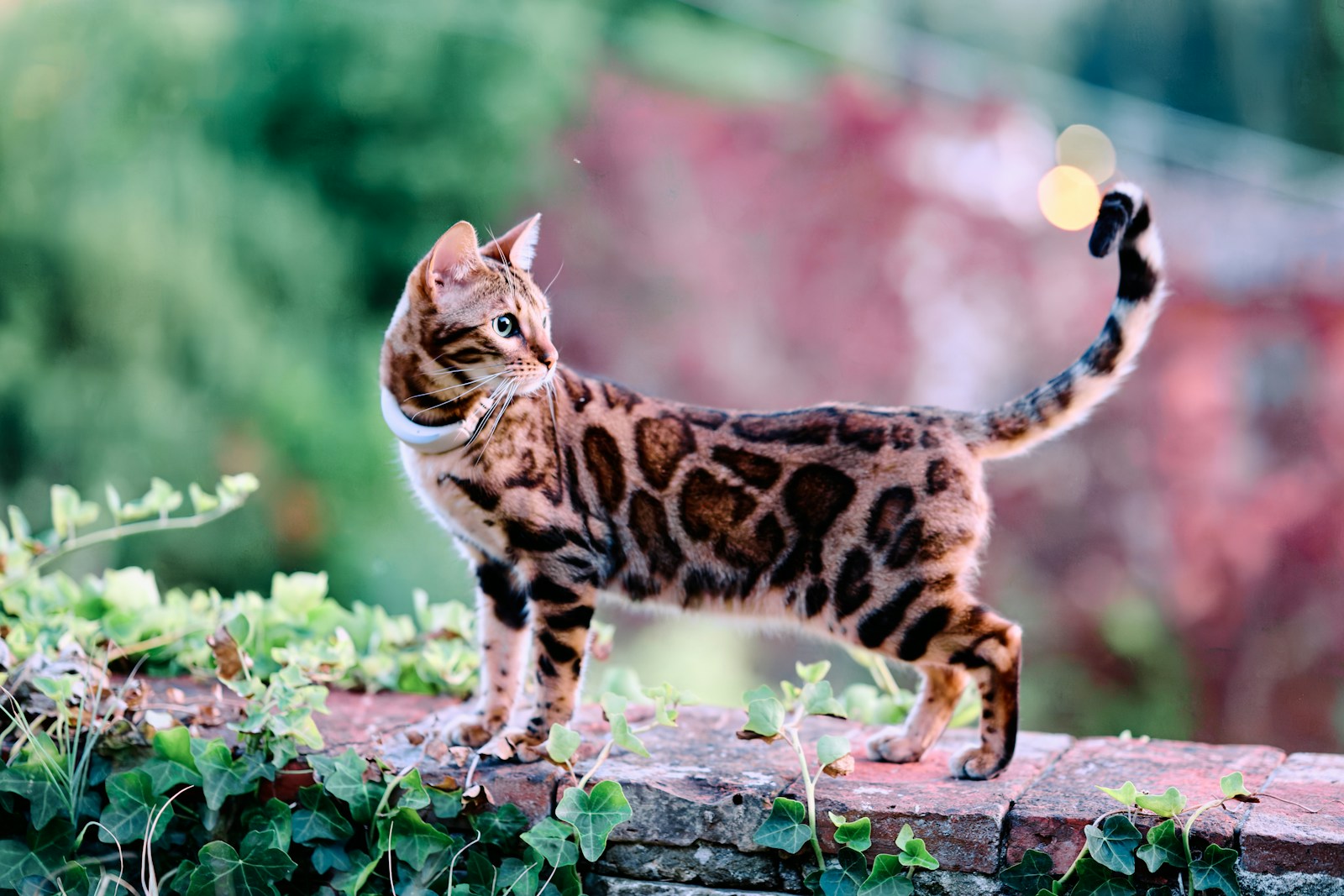
- What do Bengal cats look like?
- How big do Bengal cats get?
- What is a Bengal’s personality like?
- What does a Bengal need at home?
- How do you groom a Bengal?
- What should a Bengal eat?
- Bengal health problems and screening
- Are Bengal cats legal where you live?
- Breeder, rescue and the cost of ownership
- Is a Bengal right for you?
- When to call the vet
- Frequently asked questions
- Quick answers
Bengal cats at a glance
The Bengal is a medium to large, muscular, short-coated cat with spots, rosettes or marbling, and a very high energy level. The table below pulls together the basics from breed registries and veterinary sources. Where sources give different numbers, we show the full range.
| Trait | What sources report |
|---|---|
| Origin | United States, from crosses with the Asian leopard cat (Prionailurus bengalensis) |
| Weight | About 6 to 12 lb (VCA); females 6 to 12 lb and males 9 to 15 lb (Cuteness); up to about 17 lb at the top end (Pumpkin) |
| Time to mature | Up to about 2 years (VCA) |
| Lifespan | Commonly listed as about 12 to 16 years; ranges run from 9 to 20 depending on the source |
| Coat | Short, dense, soft and silky; spotted/rosetted or marbled tabby pattern |
| Main colors | Brown, silver and snow (seal lynx point, seal mink, seal sepia) |
| Grooming | Low; roughly weekly brushing |
| Energy | Very high |
| Voice | Talkative; VCA rates chattiness 5 out of 5 |
| Registries | TICA, GCCF, FIFe, CFA and others recognize the breed |
Where did Bengal cats come from?
Bengals were developed by crossing domestic cats with the Asian leopard cat, a small wild cat of southern and eastern Asia, and then breeding the offspring back to domestic cats over several generations. The breed’s name comes from the leopard cat’s scientific name, Prionailurus bengalensis.
Early crosses
People were writing about leopard cat and house cat mixes long before the modern breed existed. The British artist Harrison Weir mentioned such a cross in 1889. The modern story starts with California breeder Jean Mill, who in 1963 placed a domestic tomcat with a female leopard cat she had bought from a pet store, and that pairing produced a hybrid kitten.
Building a breed was hard. Domestic cats have 38 chromosomes and most of the wild cats used in hybrids have 36, according to the American Association of Feline Practitioners (AAFP). That mismatch makes live births difficult, and early-generation hybrid males are usually sterile. Breeders have to mate the female hybrids back to domestic males, generation after generation, until fertility returns, usually around the fourth generation.
Mill restarted her program in the 1970s and 1980s, adding domestic cats such as the spotted Egyptian Mau. Mill said part of her aim was to help the wild leopard cat by giving people a spotted pet that would reduce demand for wild cats and their fur.
Recognition by cat registries
The International Cat Association (TICA) accepted the Bengal as a new breed in 1986 and granted championship status in 1991. Some sources give 1983 as the year TICA first allowed registration, so dates vary a little depending on what step is being counted. The UK’s Governing Council of the Cat Fancy (GCCF) followed in 1997 and the European federation FIFe in 1999. The Cat Fanciers’ Association (CFA) was one of the last, accepting the Bengal into its Miscellaneous class in 2016 for cats at least six generations removed from non-Bengal ancestors.
What do F1, F2 and F4 mean?
“F” numbers count generations from the wild cat. An F1 has one leopard cat parent, an F2 has a leopard cat grandparent, and so on. The first three or four generations are often called “foundation” or “early-generation” Bengals. The AAFP notes that the wild genetic share drops below 15% by the fourth generation. The Bengals sold as pets today are later-generation cats bred from other Bengals, not from wild cats.
What do Bengal cats look like?
Bengals look like small wild cats: long, muscular bodies, a broad muzzle, large eyes and a short coat with high-contrast spots, rosettes or marbling. The CFA standard describes the ideal as an athletic cat with a “nocturnal expression.”
Head and body
- Head: slightly small for the body, with a full, broad muzzle and prominent whisker pads, and a large, wide nose.
- Ears: medium to small with a wide base and rounded tips, set far apart. The CFA standard counts ear tufts as a fault.
- Eyes: large and set wide apart, rounded in shape.
- Body: sleek and muscular. VCA notes the back legs are slightly longer than the front, which gives Bengals a prowling walk.
Coat patterns
There are two recognized patterns. Spotted or rosetted Bengals have spots that should look random and flow horizontally along the body. Rosettes are spots with a darker outline around a lighter center, like a leopard’s. Marbled Bengals have swirling, horizontal marbling instead of spots. Many Bengals also have “glitter,” a shimmer in the coat that shows best in sunlight.
Colors
Registries mainly recognize brown, silver and snow. Brown is the classic warm, golden-to-orange base with dark markings. Silver has a white to steel-gray base with no warm tones. “Snow” covers three pale colors: seal lynx point (the lightest, usually with blue eyes), seal mink and seal sepia. You may also hear of charcoal, blue or black (melanistic) Bengals; sources disagree on which of these are accepted for showing, and acceptance differs between registries.
How big do Bengal cats get?
Most adult Bengals weigh somewhere between about 6 and 15 pounds, and males are usually larger than females. VCA lists 6 to 12 pounds overall; other breed profiles put males at 9 to 15 pounds and allow up to about 17 pounds for large males.
Bengals often look heavier than they are because they are so muscular, and VCA notes they can take up to two years to reach physical maturity. A young adult may still be filling out. For a fuller breakdown of growth, see how big Bengal cats get.
Weight alone does not tell you whether a cat is healthy. Ask your vet to show you how to feel your Bengal’s ribs and waist, which is a better guide than the number on the scale. In an owner survey of Bengals in Belgium and the Netherlands, being overweight was the most commonly reported health issue, which surprises many people given how active the breed is.
What is a Bengal’s personality like?
Bengals are confident, curious, intelligent and very energetic. They tend to bond closely with their people and want to be involved in everything, but most are not lap cats. VCA rates them 5 out of 5 for intelligence and chattiness and 1 out of 5 as a lap cat.
Energy and intelligence
Expect a cat that runs, climbs and leaps far more than an average house cat. Bengals watch what people do and can learn to open doors and cabinets, according to VCA. Many enjoy fetch, learning tricks and walking on a harness. Sudden bursts of wild running are common in young, active cats, and our article on why cats get the zoomies explains what is normal.
A bored Bengal makes its own fun. That can mean raiding shelves, stealing small shiny objects, or knocking things off tables. The fix is more structured play, not punishment.
Voice and attention
International Cat Care describes Bengals as able to be very active, noisy and demanding. They often “talk” to get your attention, and VCA notes that some Bengals growl while they eat. If you want a quiet, independent cat, this is probably not your breed.
Water and hunting instincts
Many Bengals are fascinated by water and like to play in water bowls, dripping taps and even showers. They also have a strong prey drive. Royal Canin and Elanco both advise keeping Bengals away from pet fish, hamsters, gerbils and other small animals. Watch for the excited chattering at birds through the window, which is a classic sign of a cat in hunting mode.
Children and other pets
Bengals can do well with respectful, older children who enjoy active play, and VCA rates them 4 out of 5 with dogs. Read our answer on whether Bengal cats are good with kids for the details. With other cats, results vary. International Cat Care reports anecdotal accounts of some Bengals being very territorial toward other cats, especially in busy neighborhoods with many cats.
Does generation change temperament?
The AAFP discourages owning early-generation (F1 to F3) hybrids because they can keep wild-type behaviors such as urine spraying, unpredictable biting or scratching, and territorial behavior. It also notes that even later generations can be less predictable than typical domestic cats, and that no studies have directly compared behavior across generations. International Cat Care adds that some Bengal lines remain hard to manage as household pets. Meeting the parents and asking the breeder about temperament is important.
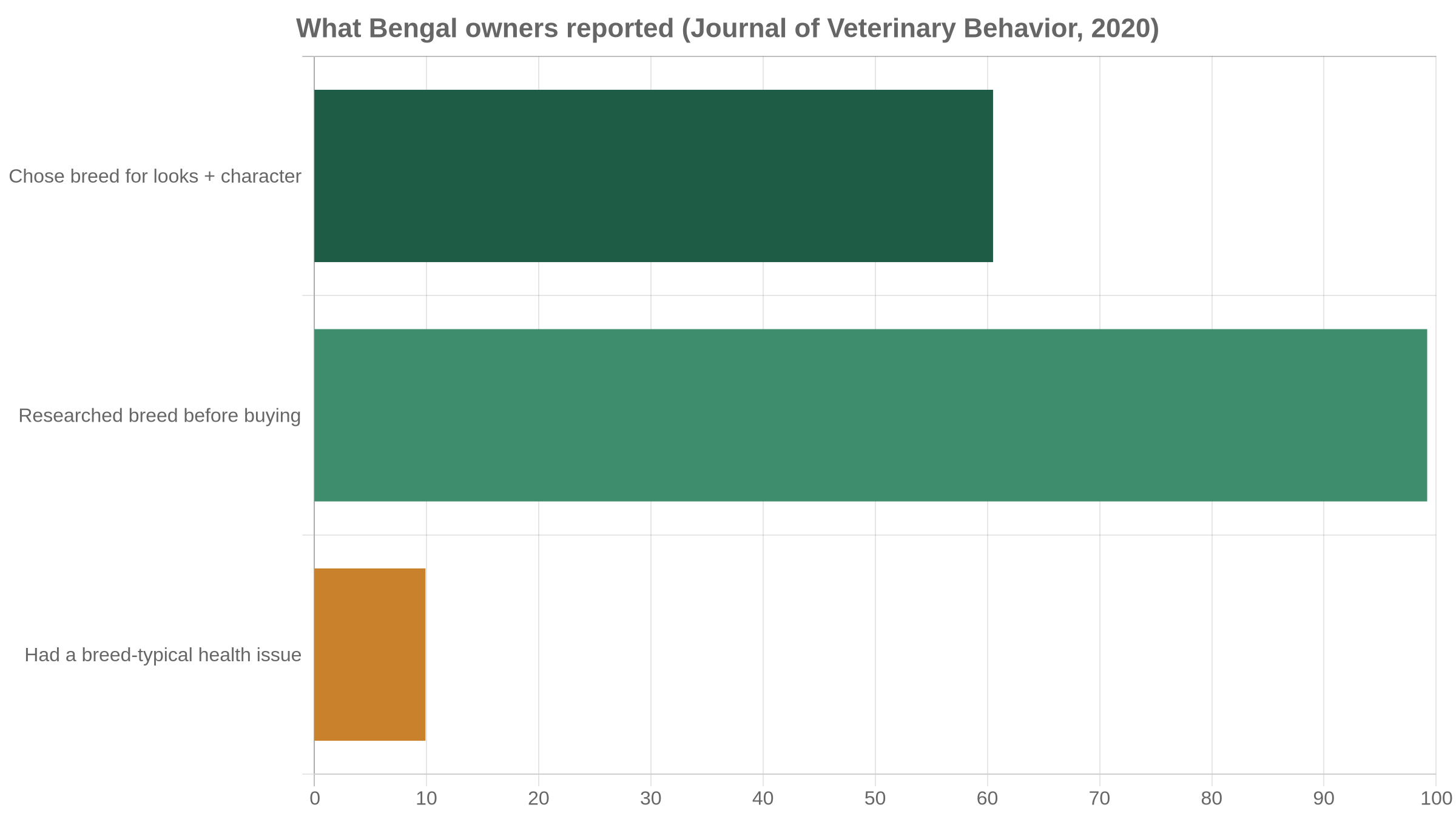
That owner survey offers some reassurance. Of the cats covered, 60.5% of owners chose the breed for a mix of looks and character, and 99.2% had looked up information about Bengals before getting one. The researchers noted that the most common behaviors were not seen as problems by owners, which could mean fewer cats given up. Doing your homework clearly matters.
What does a Bengal need at home?
A Bengal needs a home built for climbing, scratching and daily play, plus a person who will spend real time engaging it. Space helps, but structured activity matters more than square footage.
Go vertical
VCA notes that most Bengals love to survey their surroundings from high shelves and the tops of refrigerators. Give them sturdy, legal places to do it: a tall, stable cat tree, wall shelves and window perches. Our cat tree buying guide explains what to look for in height and stability, which matters a lot with a strong, jumping cat.
Scratching
Offer at least one tall, heavy scratching post and a horizontal scratcher. A muscular Bengal will topple a flimsy post and then ignore it. See our scratching post buying guide for materials and placement.
Daily play
Plan several short, active play sessions every day with wand toys that let your Bengal stalk, chase and pounce. End each session with a “catch” and a small meal or treat so the hunt feels finished. Food puzzles, rotating toys, clicker training and harness walks all help. Our indoor cat enrichment guide has a full plan.
Indoors or outdoors?
Because of their hunting drive and possible territorial behavior toward other cats, many owners keep Bengals indoors and offer safe outdoor time in a catio or on a harness. Welfare groups point out the other side of this: confining a very active cat can harm its wellbeing if its needs are not met indoors. In other words, an indoor Bengal needs extra effort, not less.
Cat-proofing
A clever cat that opens cabinets will find cleaning products, medicines and string. Use child locks, put breakables away, cover fish tanks securely and keep toilet lids down if your cat likes water. Our cat-proofing tips cover the basics.
How do you groom a Bengal?
Bengal grooming is simple: brush about once a week, trim nails regularly, and keep up with dental care. The short, silky coat rarely mats.
| Task | How often | Notes |
|---|---|---|
| Brushing | About once a week | A rubber brush or soft bristle brush works well; brush more during seasonal shedding |
| Nail check and trim | Check monthly; trim as needed | Active cats that scratch a lot may need fewer trims |
| Teeth | Ideally daily brushing | Use a cat toothpaste; dental chews can help between brushings |
| Ears and eyes | Weekly look | Look for redness, discharge or odor |
| Bathing | Rarely, only if needed | Some Bengals tolerate water better than most cats, but routine baths are not needed |
| Litter box | Scoop daily, wash weekly | Very important if you have more than one cat |
For the details, see how often to brush a cat, how often to trim cat nails and how often to bathe a cat. If you notice bad breath, that is often a sign of dental disease and worth a vet check.
Do Bengals shed, and are they hypoallergenic?
Bengals shed, but VCA rates their shedding as fairly low (2 out of 5). Some breed sites call Bengals hypoallergenic, while others, such as Elanco, say no cat is truly hypoallergenic and only that low shedding may help some allergy sufferers. If you have allergies, spend time with Bengals before you commit.
What should a Bengal eat?
Bengals do not need a special breed diet. Like all cats, they need a complete and balanced commercial food made for their life stage, fed in measured amounts that keep them lean.
- Kittens: feed a growth (kitten) food. Because Bengals mature slowly, ask your vet when to switch to adult food.
- Adults: choose a complete adult food. Wet, dry or a mix can all work; our guide to wet vs dry cat food compares them.
- Portions: measure meals rather than leaving a full bowl out. Even active Bengals can become overweight, as the owner survey showed.
- Treats: keep treats small and part of training or play.
- Water: Bengals that like to play in water may enjoy a fountain or a wide bowl, which can encourage drinking.
Be careful with human foods. Some, like plain cooked egg, are fine in small amounts, while milk and many dairy foods can upset a cat’s stomach. See can cats eat eggs, can cats drink milk and can cats eat tuna.
Bengal health problems and screening
The Bengal’s best-documented inherited problems are an eye disease called PRA-b, a red blood cell disorder called PK deficiency, and the heart disease HCM. Two of these have DNA tests; the heart disease needs an ultrasound scan. Good breeders test their breeding cats and will show you the results.
Progressive retinal atrophy (PRA-b)
PRA-b is an inherited blindness found in Bengals. According to the UC Davis Veterinary Genetics Laboratory, which helped discover the gene, the light-sensing cells of the retina begin to die at around 7 weeks of age, and affected cats have badly reduced vision by about 2 years old. Affected cats often hold their whiskers further forward and may be more vocal at night.
PRA-b is recessive, so a kitten must inherit the faulty gene from both parents to be affected. Carriers look normal and can only be found by a DNA test, which uses a simple cheek swab. UC Davis also suggests that some Bengal lines may need testing for two other PRA genes (rdAc and Rdy) because of Abyssinian ancestry.
Pyruvate kinase (PK) deficiency
PK deficiency is an inherited anemia: a missing enzyme makes red blood cells unstable so they break down early. UC Davis lists the Bengal among breeds where the mutation is found at significant frequency. Langford Vets notes the anemia is often mild, may come and go, and may not show until a cat is older. It is also recessive and can be found with a DNA test. The GCCF requires PK deficiency testing for Bengals on its active (breeding) register.
Hypertrophic cardiomyopathy (HCM)
HCM is a thickening of the heart muscle and the most common heart disease in cats of all breeds. Royal Veterinary College researchers estimate it affects about 1 in 7 cats. International Cat Care suggests Bengals may have a higher rate than some breeds.
There is no proven, widely used DNA test for HCM in Bengals. Researchers have studied gene variants in Bengal populations, but the science is still limited. For now, HCM is diagnosed with an echocardiogram (heart ultrasound), ideally done by a veterinary cardiologist. Because HCM can appear later in life, responsible breeders repeat heart scans on breeding cats over time. A heart murmur found at a checkup is a reason to discuss a scan with your vet, though not every murmur means heart disease.
Other conditions to know about
- Flat-chested kitten syndrome: a chest deformity in young kittens that International Cat Care lists for the breed. Ask breeders whether it has appeared in their lines.
- Hip dysplasia: International Cat Care notes Bengals may be predisposed. Watch for stiffness or reluctance to jump.
- Tritrichomonas foetus: a gut parasite that causes long-lasting, smelly large-bowel diarrhea. It is not specific to Bengals, but it is most common in purebred cats and cats from catteries, and most affected cats are under a year old. Shared litter boxes raise the risk. A new kitten with diarrhea that will not settle should see a vet for proper testing.
- Weight gain: the most common issue reported by owners in the Belgian and Dutch survey.
| Condition | What it affects | How it is screened | Inheritance |
|---|---|---|---|
| PRA-b | Eyes (blindness by about age 2) | DNA cheek swab; eye exam | Recessive |
| PK deficiency | Red blood cells (anemia) | DNA cheek swab or blood test | Recessive |
| HCM | Heart muscle | Echocardiogram, repeated over time | Suspected inherited; no proven Bengal DNA test |
| Flat-chested kitten syndrome | Chest shape in kittens | Physical exam of kittens | Not fully understood |
| Hip dysplasia | Hip joints | Exam and X-rays if signs appear | Possible predisposition |
Are Bengal cats legal where you live?
In most places later-generation Bengals are legal, but rules vary widely and usually target early generations. The AAFP notes that US laws on hybrid cats differ by state and even by county, with some places requiring permits or a minimum number of generations from the wild ancestor.
- United States: the AAFP names Nebraska, Georgia, Hawaii and Rhode Island as having the most restrictive hybrid laws. Catster reports that Hawaii and Connecticut ban Bengals of any generation, and that some states, such as Iowa, allow only fourth generation or later. City rules can be stricter than state rules.
- Other countries: the AAFP reports that Australia and New Zealand ban hybrid imports unless the cat is at least five generations removed from a wild ancestor, the UK requires permits for any hybrid with a wild parent, and Norway and Sweden prohibit hybrids less than five generations from a wild ancestor.
- Changing rules: in the UK, a group of welfare organizations including Battersea, Blue Cross, BSAVA and International Cat Care has called on the government to ban deliberate hybrid breeding and imports.
Laws change, so check with your state wildlife or agriculture agency and your city or county before you buy, and keep your cat’s pedigree papers.
The rabies vaccine issue
The AAFP points out that no rabies vaccine is approved by the USDA for wild or hybrid cats. Hybrids should still be vaccinated, but in some places a hybrid that bites a person may be treated differently from an ordinary cat. This is mainly a concern for early generations, and another reason to choose a later-generation Bengal with clear paperwork.
Breeder, rescue and the cost of ownership
You can get a Bengal from a breeder or through rescue. Either way, the purchase price is only the start: plan for food, enrichment gear, health screening, insurance or savings, and routine vet care over a long life.
The ethics of hybrid breeding
The AAFP strongly opposes breeding wild cats with domestic cats, citing welfare risks to both animals and the trade in wild cats. International Cat Care does not support creating hybrid breeds. If you choose a Bengal, look for a breeder who breeds Bengal to Bengal, does not keep wild cats and does not sell early generations as pets.
Questions to ask a breeder
- What generation is the kitten, and can I see the registered pedigree?
- Can I see DNA results for PRA-b and PK deficiency for both parents?
- When were the parents last scanned for HCM by echocardiogram, and by whom?
- Can I meet the mother, and ideally the father? How do they behave with strangers?
- Has the kitten been tested for gut parasites, and has it had diarrhea?
- What vaccines and vet checks has the kitten had, and what is the contract if health problems appear?
- Will you take the cat back if I can no longer keep it?
Adoption
Bengals do end up in shelters and breed rescues, sometimes because owners were not ready for their energy. An adult rescue Bengal can be a great choice because its personality is already known. Ask the rescue about energy level, how the cat handles other pets, and any known health history.
What drives the cost
Bengals are among the more expensive breeds to buy. VCA notes a show-quality Bengal can cost around $2,000, and prices vary with region, pedigree, color and quality. Ongoing costs come from:
- Quality food for a long-lived cat.
- Sturdy cat trees, shelves, scratchers and a steady supply of toys.
- Annual checkups, vaccines, dental care and possible heart scans.
- Pet insurance or an emergency savings fund.
- A catio or harness if you want safe outdoor time.
- Pet sitters, since Bengals often do poorly when left alone and bored.
Is a Bengal right for you?
A Bengal suits experienced, active cat lovers who want an engaged, playful companion and have time for it every day. It is a poor fit for people who want a calm lap cat or are away from home most of the day.
A Bengal may suit you if you:
- Enjoy daily interactive play and training.
- Can provide climbing space and plenty of toys.
- Do not mind a talkative cat that follows you around.
- Have older children or a cat-friendly dog.
- Have experience with cats, as VCA and other sources suggest.
Think twice if you:
- Want a quiet cat that naps most of the day.
- Work long hours with no one home.
- Keep pet birds, fish, hamsters or other small animals.
- Live somewhere with strict hybrid laws.
- Live in a small space and cannot add vertical territory.
When to call the vet
Call your vet promptly if your Bengal shows any of these signs. Some, marked “urgent,” need care the same day.
- Urgent: fast, noisy or open-mouth breathing, sudden weakness or wobbly or dragging back legs. These can be signs of heart disease complications.
- Urgent: pale or yellow gums, collapse, or straining in the litter box without producing urine.
- Bumping into things, reluctance to move in dim light, or widely dilated pupils, which can signal vision loss.
- Diarrhea that lasts more than a day or two, keeps coming back, or contains blood or mucus.
- Tiredness, poor appetite or weight loss.
- Stiffness, limping or reluctance to jump.
- Sudden changes in behavior, such as hiding, aggression or spraying.
- Bad breath, drooling or pawing at the mouth.
Tell your vet your cat is a Bengal so they can consider breed-linked problems, and bring any breeder health test results to the first visit.
Frequently asked questions
Are Bengal cats part wild?
Bengals have wild ancestry, but pet Bengals today are many generations removed from the Asian leopard cat and are bred Bengal to Bengal. The AAFP notes the wild genetic share is under 15% by the fourth generation. Early-generation cats (F1 to F3) are a different matter and are not recommended as pets.
Do Bengal cats like water?
Many do. VCA notes Bengals love to play in water bowls, and owners often report cats batting at taps or joining them near the shower. Individual cats vary, so never force a cat into water.
Can Bengals be left alone all day?
Long, regular absences are hard on this breed. Bengals need interaction and can become destructive or noisy when bored. If you work long hours, plan play before and after work, use food puzzles, and consider a pet sitter or a well-matched second cat.
Are Bengal cats aggressive?
Later-generation Bengals from good breeders are usually confident and affectionate, not aggressive. Rough play and biting often come from boredom or a lack of play. Early-generation hybrids are more likely to bite, scratch unpredictably or spray, according to the AAFP.
How long do Bengal cats live?
Sources commonly list about 12 to 16 years, with VCA giving 12 to 15. Some profiles quote ranges as low as 9 or as high as 20. Good screening, a lean body weight and regular vet care give a Bengal the best chance at a long life.
Can Bengals walk on a leash?
Yes, many Bengals learn to walk on a harness and leash. Start indoors with a well-fitted cat harness, reward calm behavior with treats, and move outside only once your cat is relaxed. Avoid busy areas with dogs at first.
Should I get two Bengals?
A playmate can help burn off energy, especially for owners who are out a lot. But Bengals can be territorial with some cats, so introductions need to be slow. Two kittens raised together often get along best.
Do Bengals need special food?
No. A complete and balanced food for their life stage, fed in measured portions, is enough for most Bengals. Ask your vet if your cat has a health condition that needs a special diet.
Quick answers
- How Big Do Bengal Cats Get? Most adults weigh about 6 to 12 pounds, and some males get bigger.
- Are Bengal Cats Good With Kids? Often yes with older, active children, with supervision and lots of play.
- Why Does My Cat Get the Zoomies? Short bursts of wild running are usually normal play.
- Why Does My Cat Chatter at Birds? It is excitement or frustration at prey your cat cannot reach.
- How Often Should You Brush Your Cat? About once a week for short-haired cats like Bengals.
- How Often Should You Trim a Cat’s Nails? Every 2 to 4 weeks for most indoor cats.
- Why Does My Cat Knock Things Off Tables? Usually curiosity, hunting instinct, boredom or a bid for attention.
How we researched this guide
This guide is based on breed registry standards, veterinary and welfare organization pages, a university genetics laboratory and published research listed below. Where sources disagree, such as on weight and lifespan, we give the range.
Sources
- Bengal, VCA Animal Hospitals
- Hybrid Cats Position Statement, American Association of Feline Practitioners
- Bengal, International Cat Care
- First Do No Harm, International Cat Care
- Bengal Breed Standard, Cat Fanciers’ Association
- About the Bengal, Cat Fanciers’ Association
- Progressive Retinal Atrophy (PRA-b) (Bengal), UC Davis Veterinary Genetics Laboratory
- Progressive Retinal Atrophy (PRA rdAc), UC Davis Veterinary Genetics Laboratory
- Erythrocyte Pyruvate Kinase Deficiency, UC Davis Veterinary Genetics Laboratory
- Pyruvate Kinase Deficiency, Langford Vets
- Asymptomatic Hypertrophic Cardiomyopathy: Diagnosis and Therapy, Royal Veterinary College
- New Perspectives on Feline Cardiomyopathy, VIN
- Tritrichomonas foetus in Young Cats, Royal Canin Academy
- Feline Tritrichomonas review, Journal of Feline Medicine and Surgery (PMC)
- Bengal cat owner survey, Journal of Veterinary Behavior (KU Leuven)
- Group issues position statement on hybrid cats, MRCVS Online
- Jean Mill, Wikipedia
- Bengal Cat Breed Characteristics, Cuteness
- Bengal, Pumpkin
- Let’s talk Bengals, Royal Canin
- Breed Profile: Bengal Cat, Elanco
- Are Bengal Cats Illegal in Some States?, Catster
This article is general information and is not a substitute for advice from your veterinarian.