

This guide explains how to choose a scratching post your cat will actually use: the main types, the best materials, the right height and base, where to put it, and how to train a cat to prefer it over your sofa. The single most important takeaway: a post only works if it matches how your cat already likes to scratch, and for most cats that means a tall, rock-steady, sisal-covered post placed where they spend their time.
Key takeaways
- Scratching is normal and necessary. Cats scratch to mark territory with scent and visible marks, shed old claw sheaths and stretch.
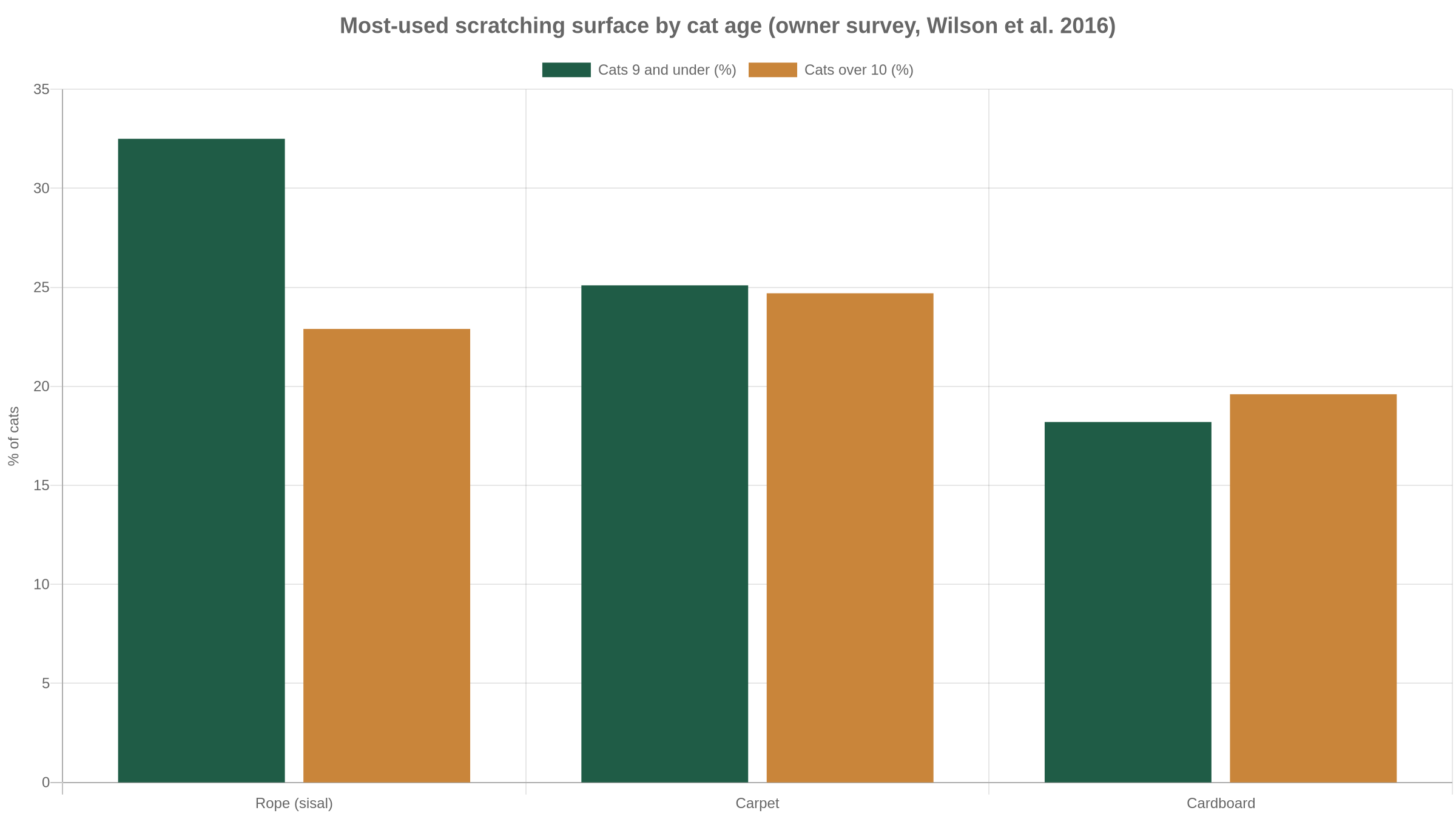
- In a large owner survey, cats used sisal rope most often when it was offered, even though carpet was the material owners bought most.
- Posts about 3 feet (90 cm) or taller were linked to less furniture scratching. International Cat Care advises at least 60 cm (about 2 feet) for an adult cat.
- Stability matters as much as material. A post that wobbles or tips can put a cat off for good.
- Put posts where your cat sleeps, plays and already scratches, not hidden in a back room.
- Reward scratching on the post. Punishment did not reduce furniture scratching in research and can make cats fearful of you.
- Offer more than one post and more than one style, especially in multi-cat homes.
In this guide
- Why do cats need to scratch?
- What type of scratcher should you buy?
- Which material do cats prefer?
- How tall and how sturdy should a scratching post be?
- How to match a scratcher to your cat
- How many scratching posts do you need, and where should they go?
- How do you get a cat to use a scratching post?
- How to protect furniture while your cat learns
- When to call the vet
- How we researched this guide
- Quick answers
- Frequently asked questions
Why do cats need to scratch?
Cats scratch because it does several jobs at once: it leaves a scent and visual message, removes the worn outer layer of the claws, and stretches the body. It is not bad behavior or revenge, so the goal is never to stop scratching, only to move it somewhere you are happy with.
Scratching is a message
The Cornell Feline Health Center describes scratching as largely a marking behavior. Glands on the paws leave scent on the surface, and the shredded fibers and shed claw sheaths act as a visible sign that the cat was there. This is the same scent-sharing instinct behind other friendly habits, such as why your cat headbutts you and why cats knead soft things. Because scratching is about marking, cats tend to choose prominent spots that other members of the household will notice: the arm of the sofa in the living room, a doorway or the end of a bed.
Scratching is claw care and a stretch
The ASPCA notes that cats scratch to pull off frayed, worn outer claw layers and expose the sharper claw beneath. They also scratch while stretching and during play. The American Association of Feline Practitioners (AAFP) points out that cats often stretch and scratch right after waking, which is why the spot next to a favorite sleeping place is prime real estate for a post. Since healthy adult cats spend a lot of the day dozing (see is it normal for my cat to sleep so much?), that gives you many chances each day to catch the post-nap scratch.
Stress can increase scratching
Researchers who surveyed thousands of owners note that marking behaviors, including scratching, tend to increase with stress, such as tension with another cat or changes in the household. VCA’s behavior guidance adds that a cat suddenly scratching new objects or new areas of the home may be marking because something has unsettled it. That matters when you are buying: if scratching has suddenly increased, a new post helps, but finding the source of stress helps more.
Why not just declaw?
Declawing is not a nail trim. It is surgery that amputates the last bone of each toe. The AAFP strongly opposes declawing as an elective procedure, the ASPCA is strongly opposed to it, and the American Veterinary Medical Association (AVMA) discourages it and supports non-surgical alternatives such as nail trims, a variety of scratching surfaces and positive reinforcement. Cornell also notes that declawing does not remove the urge to scratch. A good scratching setup is the first, and usually the only, tool you need.
What type of scratcher should you buy?
The best type is the one that copies what your cat already scratches: upright posts or cat trees for cats that stretch up on furniture, and flat or angled scratchers for cats that rake rugs and doormats. If you are not sure, start with a tall upright post and add a flat cardboard scratcher.
In the large owner survey published in the Journal of Feline Medicine and Surgery (Wilson and colleagues, 2016, with 4,105 analyzed responses), owners most often offered simple vertical posts or cat trees with two or more levels, and cats also used those two types most. Wall-mounted or hanging scratchers and single-level cat trees were used least. Homes where the favorite scratcher was wall-mounted reported the most furniture scratching of any type (74.1%), though that is an association, not proof that wall mounts cause the problem.
| Type | What it is | Best for | Watch out for |
|---|---|---|---|
| Upright (vertical) post | A single column on a weighted base | Cats that stretch up on sofa arms, chair legs or door frames | Short, light posts that wobble |
| Cat tree (2+ levels) | Several posts joined by platforms, perches or hideaways | Climbers, young active cats, multi-cat homes | Size, price and the need to anchor tall models |
| Flat (horizontal) scratcher | A pad or board, often corrugated cardboard, that lies on the floor | Cats that scratch rugs, carpet and doormats | Cardboard wears out and needs replacing |
| Angled (incline) scratcher | A ramp-shaped board | Cats that like both directions; a gentler option for some older cats | Can slide on smooth floors if not weighted |
| Wall- or door-mounted | A board or post fixed to a wall or hung on a door | Small spaces; cats that scratch drapes or door frames | Least used in the owner survey; must not swing or rattle |
| Corner scratcher | A post or panel that lets a cat scratch two sides at once | Cats that target the corners of furniture | Needs to be fixed firmly |
Upright posts
An upright post is the classic choice and the best fit for the majority of furniture scratchers. Cornell suggests a cat that climbs drapes will probably prefer a post tall enough for a long stretch. Look for a solid core (wood or thick tube), a wide, heavy base and a covering that runs nearly the full height.
Cat trees
Cat trees combine scratching with climbing and resting, which also helps with general enrichment (our indoor cat enrichment guide explains why height matters so much to indoor cats). In the survey, younger cats most often favored cat trees with two or more levels, and cat trees were linked to less inappropriate scratching than other types. If you have several cats, see our roundup of cat trees for multiple cats for size ideas.
Flat and angled scratchers
Some cats simply prefer to scratch horizontally. Cat behaviorist Pam Johnson-Bennett, speaking to Chewy, said cats that like horizontal scratching tend to target welcome mats, rugs and the tops of sofas, and she described angled scratchers as a compromise between the two directions. Cornell suggests a flattened cardboard box or even a log on its side for cats that rake carpet. In a small study of kittens, an S-shaped corrugated cardboard scratcher was preferred over a short hemp post with a toy on top, so cardboard is a sensible first scratcher for a new kitten.
Which material do cats prefer?
Most cats prefer coarse surfaces they can sink their claws into and pull against: sisal rope or fabric, rough wood and corrugated cardboard. In the biggest owner survey, sisal rope was the most-used surface when it was offered, and homes with a rope favorite reported the least furniture scratching.
The AAFP lists wood, sisal rope and rough fabric as the materials most cats prefer. Its newer environmental guidance adds that carpet, wood, rope and cardboard are all commonly preferred, and that individual cats differ. That variety is why watching your own cat matters more than any ranking.
| Material | How it feels to a cat | Durability | Good choice if your cat… |
|---|---|---|---|
| Sisal rope | Coarse, gives strong resistance | Long-lasting; frays as it is used | Shreds nubby upholstery or sofa arms |
| Woven sisal fabric | Coarse, flat, lets claws drag in a long stroke | Long-lasting | Likes long, smooth downward pulls |
| Corrugated cardboard | Soft, shreddable, very satisfying to dig into | Wears out fastest; replaceable inserts | Scratches rugs, mats or likes to lounge while scratching |
| Carpet | Soft loops or pile | Moderate | Already scratches carpet, or is an older cat |
| Wood or bark | Hard, natural grain | Very long-lasting | Scratches wooden furniture, door frames or tree trunks outdoors |
Sisal: the best default
In the Wilson survey, carpet was the material owners offered most often, but cats used rope most often when it was available. Furniture scratching was reported least when the favorite post was rope (53.7% of those homes) compared with cardboard (60.2%), carpet (63.1%) and wood (64.4%). Cornell recommends sisal or another rope-like material for cats that go after couches and other nubby surfaces. International Cat Care notes that a vertical weave is often considered better because claws can drag straight down, though plenty of cats happily use posts wrapped in horizontal sisal rope.
Does a carpet post teach a cat to scratch carpet?
Many owners worry about this, and International Cat Care acknowledges the concern. Cornell takes a practical view: if your cat already scratches carpet, a carpet-covered post is a good way to offer the texture it likes in a place you approve of. Age matters too. In the survey, cats older than about 10 preferred carpet slightly more often than rope, possibly because a softer surface is kinder to stiff joints. If you have an older cat, our senior cat care guide covers other home changes that help.
Cardboard: cheap, popular and temporary
Cardboard scratchers are inexpensive, and many cats love shredding them. The trade-off is that they wear out and shed bits of cardboard. Choose models with replaceable inserts, and treat cardboard as a second scratcher alongside a sturdy post rather than the only option for a cat that stretches up.
How tall and how sturdy should a scratching post be?
A scratching post should be tall enough for your cat to stretch out fully with front legs extended, which for most adult cats means at least 2 feet (60 cm), and ideally around 3 feet (90 cm). It must also stay completely still while your cat pulls on it.
Height
Sources agree on the principle and differ a little on the number. Cornell says a post should be at least as tall as your cat standing on its hind legs with its front legs stretched out. International Cat Care advises a minimum of 60 cm (about 2 feet) for an adult cat. The Wilson survey found less furniture scratching in homes where the favorite post was over 3 feet tall (55.2%) than where it was shorter (64.7%). Interestingly, the same survey found cats used shorter posts more often overall, simply because shorter posts are more common. Taken together, a post of 2 to 3 feet is the practical range, and taller is better for big cats. Large breeds such as the Maine Coon or a full-grown Bengal (see how big do Bengal cats get?) need the top end of that range.
Stability
The AAFP says posts should be firmly anchored so they give the resistance a cat needs. Cornell stresses that any post you buy or build should be sturdy enough that it does not topple over during use. A post that rocks, or worse, falls on a cat, can create a lasting bad association. Practical checks:
- Push the top of the post sideways with firm pressure. It should not tip or rock.
- Look for a wide, heavy base. As an example of scale, the SmartCat Ultimate Scratching Post, a widely sold sisal post, pairs a 32-inch height with a 16 x 16 inch base, according to its retailer listings.
- Anchor tall cat trees to a wall with a furniture strap, especially if you have large or very active cats.
- Check screws and joints every few weeks, since vigorous scratching loosens them.
Width of the base and post
Based on their survey, Wilson and colleagues concluded that a good first recommendation is a post with rope, upright, 3 feet or higher, with two or more levels and a base between 1 and 3 feet wide. Very wide bases were less common and less used. The scratching surface itself should be wide enough for both front paws side by side.

How to match a scratcher to your cat
Watch where, how and when your cat scratches for a few days, then buy a scratcher with the same direction, texture and height. Cornell calls this the first step in redirecting scratching, and it saves money on posts your cat will ignore.
Ask yourself these questions while you observe:
- Direction: Does your cat stretch up with paws above its head, or rake a flat surface on the floor?
- Texture: Is the target nubby upholstery, smooth wood, loop carpet, a sisal doormat?
- Height: How high do the claw marks go? Your post should reach at least that far.
- Location: Is it a doorway, the sofa in the main room, beside the bed?
- Timing: Right after waking, when you come home, after play or during a burst of energy? Cats often scratch during wild play sessions too (see why does my cat get the zoomies?).
| If your cat scratches… | Try first | Add later |
|---|---|---|
| The arm or back of the sofa | Tall sisal post right beside the sofa | Cat tree in the same room |
| Rugs, carpet or doormats | Flat cardboard or carpet scratcher on the floor | Angled scratcher |
| Drapes or climbs furniture | Tall, anchored cat tree or floor-to-ceiling post | Window perch |
| Door frames or wall corners | Corner scratcher or tall post at that doorway | Sturdy door-mounted board |
| The mattress or bed frame | Post next to the bed | Flat scratcher by the bedroom door |
| Anything and everything (kitten) | Corrugated cardboard scratcher | Sisal post as the kitten grows |
| Less than before (senior cat) | Low, wide angled or flat scratcher | Carpet-covered post |
Kittens
Kittens are learning where scratching belongs, so the earlier they have good options, the better. In the kitten study mentioned above, an S-shaped cardboard scratcher won out over a small hemp post. That study was small, with only a handful of kittens per comparison, so treat it as a hint rather than a rule. As kittens grow, add a full-height post so the habit transfers to an adult-sized target.
Senior and arthritic cats
Older cats often still want to scratch but may struggle with tall, hard posts. In the Wilson survey, cats aged about 10 to 13 favored simple upright posts first, and older cats preferred carpet more often than younger ones. The authors suggested arthritis and lower activity may explain the shift. Offer an angled or low scratcher with a softer surface near where your older cat rests, and keep claws trimmed, since older cats often wear them down less. Our nail trimming guide walks through the steps.
How many scratching posts do you need, and where should they go?
Most homes need more than one: at least one scratcher in each area where your cat spends time or already scratches, plus extra for multi-cat homes. International Cat Care suggests a minimum of three scratching posts for a two-cat home.
How many?
Most owners in the Wilson survey already offered several posts. Furniture scratching went down as the number of different post types and styles in the home went up, and homes with more than 10 posts reported it in about a third of cases (32.4%), compared with about 60% of homes with up to seven. You do not need ten posts, but variety clearly helps. A sensible plan for one cat is one tall post plus one flat scratcher. For two cats, start with three scratchers in different spots so no cat has to share or guard the only one.
Where to put them
- Next to the problem spot. Cornell advises placing a post directly beside the furniture your cat scratches, then moving it gradually to where you would prefer it.
- Near sleeping places. The AAFP suggests placing posts next to where cats sleep, because they scratch on waking.
- In social, visible areas. Because scratching is a signal, VCA notes most cats prefer posts in prominent places. A post hidden in a spare room sends no message.
- At entrances. Doorways and hallways between rooms are common marking spots.
- By windows. A tall post or tree near a window combines scratching with a lookout spot for birdwatching (and the chattering that sometimes comes with it; see why does my cat chatter at birds?).
One more finding from the survey is worth knowing: in nearly 70% of homes with a furniture scratching problem, there was already a post in the same room, often just a few feet away. Placement alone is not always enough. The post also has to be the right type, texture and height, and the cat needs encouragement to use it.
How do you get a cat to use a scratching post?
Make the post attractive and reward your cat every time it uses it. Lure your cat to the post with play or treats, praise and reward scratching there, and keep at it for a few weeks. Never force your cat’s paws onto the post or punish scratching elsewhere.
Step by step
- Set it up in the right place. Put the new post beside the spot your cat already uses or next to its bed.
- Make it interesting. Drag a wand toy up and around the post so your cat’s claws catch the surface during play.
- Reward on the spot. When your cat scratches the post, offer a small treat, gentle praise or a stroke, whatever your cat values.
- Repeat at peak times. Play near the post after naps, at feeding time and when you come home.
- Move slowly. Once the post is in regular use, shift it a little each day toward where you want it to stay.
- Leave it messy. Do not replace a shredded post too quickly. Cornell notes a ragged post is a sign it is doing its job, and the ASPCA points out that used posts smell and look familiar.
Training in small, positive steps works for many cat habits. The same patient approach helps when you get a cat used to a carrier.
Does rewarding really help?
The survey data says yes. Owners who rewarded their cat with treats, praise or petting were more likely to report daily use of the favorite post (80.4%) than owners who never rewarded it (67.7%). By contrast, scolding, picking the cat up or redirecting it did not change how often cats scratched furniture.
Catnip and pheromone sprays
The AAFP suggests enticing cats to a post with catnip, treats or toys. Catnip is a reasonable thing to try, and our article on whether catnip is bad for your cat covers safety. Do not count on it, though: not every cat responds to catnip, and in the small kitten study, dried catnip, catnip oil and other cats’ hair did not change scratching on a cardboard scratcher.
There is also a synthetic version of the scent cats leave from their paw pads, sold for scratching posts. In a 2013 randomized, blinded study of 19 cats, posts treated with this synthetic feline interdigital semiochemical were scratched for longer and more often than posts with a placebo. A later evidence summary rated the overall evidence as weak, partly because of small numbers and because one study author was linked to the commercial product. It may help some cats, but it is an add-on, not a replacement for the right post in the right place.
Things not to do
- Do not hold your cat’s paws on the post. International Cat Care describes this as old advice, and the ASPCA warns it can frighten cats and make them avoid the post.
- Do not yell, spray water or punish. Cornell explains that cats link punishment with you, not the scratching, and simply learn to scratch when you are out.
- Do not throw out a well-used post just because it looks scruffy.
How to protect furniture while your cat learns
While your cat learns, make the furniture less appealing and the post more appealing at the same time. Cover favorite targets, clean off scent marks, keep claws trimmed and consider soft nail caps for cats that tolerate handling.
- Block or cover. Cornell notes restricting access is the only guaranteed way to stop scratching on a specific item. Throws, plastic sheeting or double-sided tape make surfaces less attractive. The AVMA also mentions sticky tape or foil.
- Remove the scent. Because cats re-mark spots that already smell of them, Cornell suggests cleaning scratched areas with an odor neutralizer.
- Trim claws. Regular trims reduce damage. See our step-by-step nail trimming guide.
- Nail caps. Soft plastic caps glued over the claws let a cat go through the motion without damage. Cornell says they are only for cats that accept paw handling and need replacing every 6 to 12 weeks.
- Cat-proof the rest. Our cat-proofing tips help protect other belongings at the same time.
Always pair a deterrent with an appealing scratcher right next to it. Taking away a favorite spot without offering a better one just moves the problem to the next piece of furniture.
Buying checklist: features that matter
Before you buy, check the height, stability, surface, direction and how easy it is to refresh. Decor and extras come last.
- Height: at least 2 feet (60 cm) of usable scratching surface for an adult cat; around 3 feet or more for large cats.
- Base: wide and heavy enough that the post does not move under a hard pull. Plan to anchor tall trees.
- Surface: sisal rope or woven sisal for most cats; carpet or cardboard to match specific habits.
- Coverage: the covering should run most of the post’s height, not just a short band.
- Direction: upright, flat or angled to match your cat.
- Replaceable parts: cardboard inserts or rewrappable posts extend life.
- Extras: perches and hideaways are a bonus. Dangling toys are fine but are not the main reason cats use a post.
- Assembly: check that the post screws firmly into the base and has no sharp hardware exposed.
As a reference point for one widely available model, retailer listings describe the SmartCat Ultimate Scratching Post as a 32-inch, four-sided woven sisal post on a 16 x 16 inch wood base. Certified cat behavior consultant Joey Lusvardi, speaking to Rover, named it his favorite scratching post. It was listed at $59.99 at Chewy and Mud Bay when we checked; prices change often, so check current prices before you buy. We mention it only as an example of the specifications this guide recommends, not as the only good option.
When to call the vet
Scratching itself is healthy, but a sudden change in scratching or in your cat’s claws or paws is worth a vet visit. Call your veterinarian if you notice any of the following:
- Your cat suddenly stops scratching, or avoids jumping and climbing, which can be a sign of pain such as arthritis.
- Limping, licking or chewing a paw, swelling, bleeding or a broken claw.
- A claw growing into the paw pad, which is more common in older cats.
- A sudden increase in scratching in new places, especially around doors and windows, along with other signs of stress such as hiding, spraying or fighting with another cat. VCA notes this can be linked to anxiety.
- Scratching that comes with litter box changes, appetite changes or behavior that is unusual for your cat.
If furniture scratching continues despite the right posts and rewards, your vet can check for underlying causes and may refer you to a veterinary behaviorist.
How we researched this guide
Catish has not tested any scratching posts for this guide. It is based on published guidance from veterinary and welfare organizations (the AAFP, AVMA, ASPCA, Cornell Feline Health Center, International Cat Care and VCA), peer-reviewed studies on cat scratching behavior, comments by named cat behavior experts in reputable outlets, and manufacturer and retailer specifications. Where sources differ, such as on minimum post height, we give the range. We do not use affiliate links.
Quick answers
- Why do cats knead? It is a comfort behavior from kittenhood that also leaves scent from the paws.
- Why does my cat headbutt me? To leave its scent on you and show trust.
- Is catnip bad for cats? No, it is generally safe, but not every cat reacts to it.
- Why does my cat get the zoomies? Short bursts of wild play that are usually normal.
- Is it normal for my cat to sleep so much? Yes, healthy adults often sleep 12 to 16 hours a day.
- How do I get my cat used to a carrier? Leave it out, add treats and train in small steps.
- Why does my cat chatter at birds? Excitement or frustration at prey it cannot reach.
Frequently asked questions
Do indoor cats really need a scratching post?
Yes. Indoor cats still need to mark, stretch and care for their claws, and without an approved outlet they will use furniture. In the Wilson survey, cats living fully indoors used their posts multiple times a day more often than cats with outdoor access.
What is the best material for a cat scratching post?
Sisal rope or woven sisal suits most cats and was the most-used surface in the largest owner survey. Cardboard, carpet and wood also work well for cats that already prefer those textures.
How tall should a scratching post be?
Tall enough for your cat to stretch fully with front legs extended. International Cat Care suggests at least 60 cm (about 2 feet) for adults, and posts over 3 feet were linked to less furniture scratching.
Why does my cat ignore its new scratching post?
The most common reasons are the wrong direction or texture, a post that wobbles or is too short, or a poor location. Move it next to where your cat scratches or sleeps, check that it is stable, and reward every use.
How many scratching posts does a cat need?
At least one in each main area your cat uses, ideally in more than one style. For two cats, International Cat Care recommends three posts as a minimum.
When should I replace a scratching post?
Replace it when it becomes unstable or the surface is worn down to the core, not just because it looks shredded. A frayed post carries your cat’s scent and is often its favorite. Replace cardboard inserts as they wear through.
Can I stop my cat scratching without declawing?
Yes. The AAFP, AVMA and ASPCA all point to non-surgical options: suitable scratchers, rewards, nail trims, deterrents on furniture and soft nail caps. For most cats, the right post in the right place solves the problem.
Are cat trees better than scratching posts?
Not always, but cat trees with two or more levels were among the most-used scratchers in research and were linked to less furniture scratching. They are especially useful for climbers and multi-cat homes, while a simple tall post can be enough for one cat.
Sources
- Owner observations regarding cat scratching behavior: an internet-based survey, Journal of Feline Medicine and Surgery (Wilson et al., 2016)
- Feline Behavior Problems: Destructive Behavior, Cornell Feline Health Center
- AAFP Position Statements (scratching and declawing), Journal of Feline Medicine and Surgery
- Declawing Position Statement, American Association of Feline Practitioners
- Setting Up the Environment for Success, American Association of Feline Practitioners
- What do we mean by scratching and why do cats do it?, International Cat Care
- Destructive Scratching, ASPCA
- Alternatives to declawing, American Veterinary Medical Association
- House of Delegates approves streamlined declawing policy, AVMA
- Cat Behavior Problems: Scratching Behavior, VCA Animal Hospitals
- Preference of kittens for scratchers, Journal of Feline Medicine and Surgery
- Induction of scratching behaviour in cats: efficacy of synthetic feline interdigital semiochemical, Journal of Feline Medicine and Surgery
- Use of the feline interdigital semiochemical to redirect unwanted scratching, Veterinary Evidence
- Cat Scratching Posts to Match Your Kitty’s Scratching Style, Chewy
- Why cats scratch posts, Rover
- SmartCat The Ultimate 32-in Sisal Cat Scratching Post, Chewy
- SmartCat The Ultimate Cat Scratching Post, 32-in, Mud Bay
This article is general information and is not a substitute for advice from your veterinarian.